

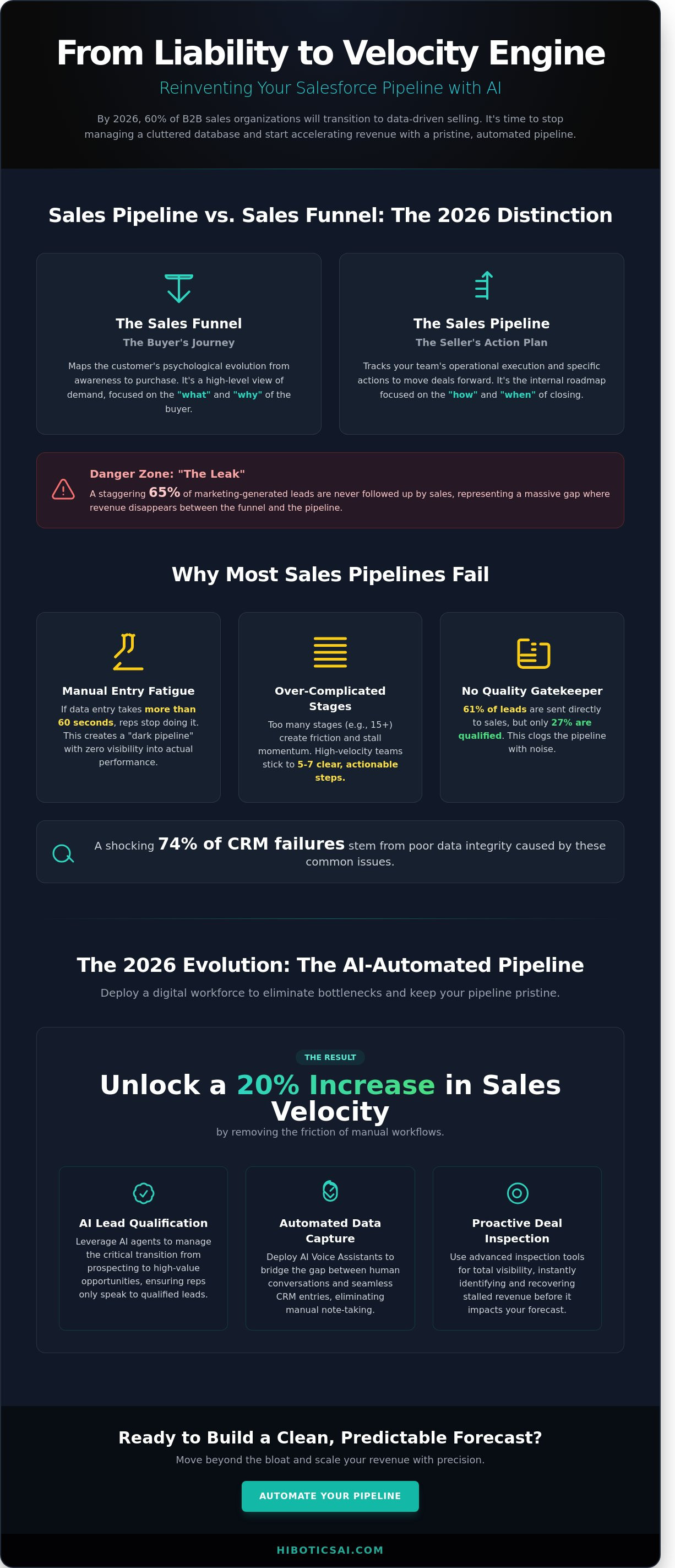
Your CRM isn't a database; it's a liability if it's filled with "zombie" leads and manual errors. By 2026, Gartner projects that 60% of B2B sales organizations will transition from experience-based to data-driven selling, yet most leaders still struggle with a salesforce pipeline that lacks basic visibility. You're likely tired of chasing reps for updates or staring at a forecast that feels more like a wish list than a roadmap. It's frustrating to watch high-value deals stall because your team is buried in the administrative debt of manual data entry.
We're here to change that dynamic. You'll discover how to transform your CRM into a high-velocity revenue engine by implementing custom AI solutions that automate lead flow and eliminate bottlenecks. We've seen organizations unlock a 20% increase in sales velocity simply by removing the friction of manual workflows. This guide breaks down the exact strategies you need to build a clean, predictable forecast and deploy a digital workforce that keeps your pipeline pristine. Let's move beyond the bloat and scale your revenue with precision.
Key Takeaways
- Transform your CRM into a high-velocity revenue engine by mastering the salesforce pipeline as your definitive source of truth.
- Differentiate your tactical seller action plan from the customer journey to eliminate operational friction and align team execution.
- Accelerate lead qualification by leveraging AI agents to manage the critical transition between prospecting and high-value opportunities.
- Identify and recover stalled revenue instantly using advanced inspection tools designed for total visibility and proactive deal management.
- Deploy AI Voice Assistants to automate data capture and bridge the gap between human conversations and seamless CRM entries.
What is a Salesforce Pipeline? Defining the Modern Sales Engine
In 2026, a salesforce pipeline is no longer a passive list of names. It's a high-velocity, dynamic engine that visualizes your entire revenue lifecycle in real time. Static spreadsheets are relics. Today, your pipeline serves as the ultimate truth-source for revenue forecasting. It dictates whether your business scales or stagnates. When you integrate your pipeline correctly, you align sales, marketing, and customer success teams under one unified strategy. This alignment ensures every lead follows a precise, automated path. Understanding the Sales Development Fundamentals is critical here; it establishes the organizational structure needed to feed the top of your funnel with surgical precision.
Your pipeline is the heartbeat of your enterprise. Top-tier firms treat it as a live digital twin of their market presence. This visibility allows you to pivot strategies before a slow month becomes a failed quarter. By bridging the gap between departments, you leverage a unified data set that keeps every stakeholder focused on the same growth targets. It's about moving from reactive guessing to proactive execution.
The Core Components of a Healthy Pipeline
High-performing teams focus on three critical metrics to maintain momentum and ensure the salesforce pipeline remains a tool for growth rather than a source of confusion.
- Total deal value: Volume is a vanity metric. A $10 million pipeline means nothing if the win rate is 2%. Focus on qualified value to understand your true potential.
- Sales velocity: This measures the hours and days from first contact to closed-won. Speed wins deals. If your average cycle exceeds 90 days, you're losing money to friction.
- Data integrity: Your pipeline is only as good as the data inside it. Recent industry audits show that 74% of CRM failures stem from poor data entry. Real-time updates are non-negotiable for accuracy.
Why SMEs Fail at Pipeline Management
Small and medium enterprises often sabotage their own growth through unnecessary complexity and operational bottlenecks. Efficiency requires a lean approach.
- Over-complicating stages: Small teams don't need 15 different stages. This creates friction and stalls momentum. Stick to 5-7 clear, actionable steps that move the needle.
- Manual entry fatigue: Sales reps hate administrative work. When data entry takes more than 60 seconds, they stop doing it. This leads to "dark" pipelines where management has zero visibility into actual performance.
- Lack of a Gatekeeper: Without a lead quality gatekeeper, your pipeline gets clogged with noise. Statistics show that 61% of B2B marketers send all leads directly to sales, but only 27% of those leads are actually qualified for a conversation.
To win, you must transform your pipeline from a cluttered database into a streamlined conversion machine. It's time to stop managing lists and start accelerating revenue.
Sales Pipeline vs. Sales Funnel: Understanding the 2026 Distinction
Stop treating your funnel and your pipeline as interchangeable terms. They serve different masters. The funnel tracks the buyer's psychological evolution; the pipeline tracks your team's operational execution. In a high-performance salesforce pipeline, these two systems must sync without friction to prevent revenue stagnation. While the funnel is a map of the customer journey, the pipeline is your internal action plan.
By 2026, B2B buying cycles have become radically non-linear. Research from 2024 indicates that 77% of B2B buyers describe their latest purchase as very complex or difficult. They don't move from A to B in a straight line. They loop back, revisit research, and involve an average of 11 stakeholders in every deal. Your salesforce pipeline must account for this volatility. It requires a system that tracks rep activities even when the buyer's path looks like a web rather than a corridor.
The most dangerous point in your revenue engine is "The Leak." This occurs in the transition between marketing engagement and sales action. Data shows that 65% of marketing-generated leads are never followed up by sales. This gap exists because the funnel doesn't automatically trigger pipeline stages. To fix this, you must Effectively Manage Sales Pipeline visibility to ensure every marketing signal converts into a tangible sales task.
The Funnel: A Perspective on Buyer Psychology
The funnel focuses on the "what" and "why" of the buyer. It categorizes leads into Awareness, Consideration, and Decision stages. Marketing activities like whitepaper downloads or webinar attendance feed the Top of Funnel (TOFU). Success here is measured by engagement metrics: click-through rates, time on page, and lead scores. It's a psychological framework designed to move a cold prospect toward a brand preference. If your funnel is stagnant, your brand lacks authority.
The Pipeline: A Perspective on Operational Execution
The pipeline focuses on the "how" and "when" of the seller. It consists of concrete stages: Prospecting, Discovery, Negotiation, and Closing. This is where you track rep activities like outbound calls, personalized demos, and contract proposals. Each stage links to specific revenue milestones. While the funnel measures interest, the pipeline measures velocity and probability. Precision here allows you to forecast revenue with 95% accuracy. To optimize these workflows, you can leverage custom AI solutions that automate the transition from lead to opportunity.
- Funnel focus: Conversion rates and buyer sentiment.
- Pipeline focus: Deal size, win rates, and sales cycle length.
- 2026 Requirement: Real-time data syncing between both to eliminate the "dead zone" between marketing and sales.
Efficiency isn't just about working harder; it's about eliminating the friction between these two models. When your funnel insights inform your pipeline actions, you unlock a level of scalability that manual processes can't match. This integration transforms your CRM from a digital filing cabinet into a proactive revenue engine.
The 7 Essential Stages of a Salesforce Pipeline
Your salesforce pipeline functions as the central nervous system of your revenue operation. Without clear, defined stages, it's just a chaotic list of names. Mapping these seven stages transforms abstract goals into a repeatable science. Building a Successful Sales Pipeline requires moving beyond guesswork and into structured data that reflects the actual buyer's journey.
- Prospecting: This is the volume phase. You identify high-fit leads and initiate first contact through multi-channel outreach.
- Qualification: The most critical gate. You determine if the lead has the budget, authority, and need to move forward.
- Discovery/Meeting: Reps uncover the specific pain points. You aren't just selling a tool; you're diagnosing a business problem.
- Proposal/Quote: You present the ROI-driven solution. This stage often involves handling initial pushback on pricing or implementation timelines.
- Negotiation: You iron out the final details. This is where you secure a firm commitment from all stakeholders.
- Closed-Won/Lost: The outcome is documented. Every "no" provides essential data to refine your future approach.
- Post-Purchase/Nurture: The deal doesn't end at the signature. You transition the client to customer success to unlock expansion revenue.
Stage 2: Why Lead Qualification is the #1 Bottleneck
Junk leads kill sales momentum. Research indicates that sales reps spend 66% of their day on non-selling activities, often chasing prospects who will never buy. When low-intent inquiries clog your salesforce pipeline, your top performers burn out. Implementing ai lead qualification solves this by filtering leads before they reach a human. By 2026, "sales-ready" means a lead has already engaged with an AI agent to confirm their timeline and technical requirements. This ensures your team only speaks to high-intent buyers ready to sign.
Standardising Your Stages for Team Consistency
Stage Exit Criteria is the only way to ensure pipeline accuracy. Use the Salesforce "Path" feature to display specific fields and guidance at each step. This keeps the team aligned on what constitutes progress. Assigning specific "Probability" percentages, such as 20% for Discovery and 85% for Negotiation, allows for 95% forecasting accuracy. When every rep follows the same roadmap, your data remains clean and your growth becomes predictable. Stop guessing and start measuring the velocity of every deal.
Optimising Pipeline Visibility and Inspection
Visibility is the backbone of predictable growth. Salesforce Pipeline Inspection provides a unified command centre for sales managers to track deal health in real time. This tool eliminates the guesswork that plagues manual reporting. Use it to identify "Stalled Deals" before they vanish from your forecast. Data from industry benchmarks indicates that deals remaining inactive for more than 14 days have a 60% lower probability of closing. By flagging these stagnation points early, you empower your team to pivot their strategy or re-allocate resources to more promising leads.
Effective management requires deep activity tracking. You must know if your reps are executing the necessary touchpoints to move the needle. High-performance teams use automated logging to ensure every call, email, and meeting is recorded. This level of detail allows you to build robust dashboards that communicate pipeline health to stakeholders instantly. Instead of hour-long status meetings, you provide a live, visual representation of your salesforce pipeline that drives immediate accountability.
Key Metrics to Monitor Every Monday
Success starts with the right numbers. Monitor your win rate by stage to pinpoint exactly where prospects drop off. For instance, if you lose 40% of your leads during the proposal stage, your value proposition likely needs refinement. Track your average deal size to ensure your salesforce pipeline aligns with your annual revenue targets. Finally, maintain a Pipeline Coverage Ratio of at least 3x. If your target is $1M, you need $3M in active deals to account for natural churn and unexpected losses.
Solving the "Dirty Data" Problem
Manual data entry is the primary cause of pipeline failure. It's slow, prone to error, and universally disliked by sales reps. Research shows that up to 70% of CRM data decays annually when left to manual processes. You must shift toward "Zero-Touch" CRM updates. Use AI-driven automation to sync communications and update deal stages without human intervention. This transition supports a rigid cultural standard: if it isn't in Salesforce, it didn't happen. This mindset ensures your data remains a reliable strategic asset rather than a liability.
Stop losing revenue to invisible bottlenecks and outdated data. Leverage our custom AI solutions to automate your pipeline inspection and unlock total operational clarity.
The 2026 Evolution: Automating Your Pipeline with AI
The sales landscape is undergoing a radical shift. By 2026, manual data entry will be a relic of the past. AI voice assistants like HiBotics AI now function as the ultimate SDR for your salesforce pipeline. These agents don't just record conversations; they execute complex workflows. They identify intent, schedule follow-ups, and update records while the prospect is still on the line.
Traditional pipelines often suffer from a 27% data decay rate due to human error or neglect. HiBotics AI eliminates this friction by closing the gap between a phone call and a CRM entry instantly. Every nuance of a verbal commitment is captured, categorized, and synced. This creates a high-fidelity data stream that powers advanced predictive analytics.
Salesforce Einstein thrives on this level of detail. By analyzing the rich data fed from AI interactions, Einstein predicts win likelihood with over 85% accuracy. It prioritizes leads based on actual behavioral patterns rather than gut feelings. This leads to the "Autonomous Pipeline," a future where deals move through stages automatically based on buyer actions and AI-driven triggers. Revenue becomes predictable because the system removes human bottlenecking.
Integrating AI Voice with Salesforce
Implementing ai appointment scheduling creates pipeline entries without any human intervention. This technology moves leads from "Raw" to "Discovery" in under 4 minutes, ensuring momentum is never lost. By automating these early-stage interactions, you buy back 15 hours per week for every rep on your team. This reclaimed time allows your top talent to focus on high-value closing activities rather than administrative upkeep of the salesforce pipeline.
Building Your Future-Proof Sales Stack
A robust CRM integration is the non-negotiable foundation of any AI strategy. HiBotics AI acts as the digital workforce that feeds your Salesforce engine, ensuring your data remains clean, current, and actionable. To stay competitive, sales leaders must audit their current stages and identify where manual entry creates lag. Automate your entry points to transform your pipeline into a self-sustaining revenue machine. Leverage custom AI solutions to ensure your tech stack isn't just a database, but a proactive growth driver.
Dominate the 2026 Revenue Landscape
The window for traditional sales management is closing. By 2026, market leaders will distinguish themselves through a salesforce pipeline that prioritizes velocity and AI-driven intelligence. You now have the strategic framework to master the 7 essential stages and move beyond the static funnels of the past. Success requires more than just a plan; it demands a technological edge that buys back your team's time.
Industry research shows that sales representatives often spend roughly 66% of their day on non-selling activities. You can change that narrative immediately. Unlock a cleaner, faster pipeline with HiBotics AI automation to transform your operations into a high-performance engine. Our custom solutions provide 24/7 automated lead qualification and seamless Salesforce CRM integration. We eliminate manual data entry so your elite talent can focus on closing high-value deals and driving ROI.
Stop managing operational bottlenecks and start scaling your vision. The technology exists to turn your CRM into a self-sustaining growth machine that works while you sleep. It's time to lead the evolution and claim your market share.
Frequently Asked Questions
What is the difference between a lead and an opportunity in Salesforce?
A lead is an unqualified contact or prospect, while an opportunity represents a qualified deal with a quantified value. Within your salesforce pipeline, a lead becomes an opportunity once it meets specific criteria like budget or authority. Industry data shows that B2B companies convert approximately 13 percent of leads into opportunities. This transition marks the point where sales teams commit resources to closing the deal.
How many stages should a typical sales pipeline have?
A high-performing pipeline typically consists of 5 to 7 distinct stages. Research from InsightSquared indicates that pipelines exceeding 8 stages experience a 14 percent decrease in sales velocity due to administrative friction. Keep your stages clear and objective. This lean structure ensures your team spends time selling rather than navigating complex internal processes.
How do I calculate sales velocity within my Salesforce pipeline?
Calculate sales velocity by multiplying your number of opportunities by your average deal value and win rate; then divide that total by your average sales cycle length. This metric tracks how quickly revenue moves through your salesforce pipeline. Top-tier sales organizations target a 25 percent annual increase in this figure. Monitoring this data allows you to identify bottlenecks and optimize your conversion points for maximum ROI.
What is Salesforce Pipeline Inspection and who is it for?
Salesforce Pipeline Inspection is a specialized dashboard designed for sales managers and reps to track deal changes and health in real-time. It highlights shifts in close dates, deal amounts, and forecast categories. This tool provides visibility into 4 critical metrics, helping teams prioritize high-value accounts. It's built for leaders who need to identify at-risk deals before they impact quarterly targets.
Can I automate the movement of deals between pipeline stages?
You can automate deal progression using Salesforce Flow or AI-driven triggers based on specific customer actions. Gartner research confirms that automation eliminates 30 percent of manual data entry tasks. This acceleration keeps your data clean and your reps focused on high-level strategy. Automating these transitions ensures your pipeline reflects reality without requiring constant human intervention.
How often should a sales manager review the pipeline?
Managers should conduct formal pipeline reviews at least once per week to maintain momentum. Companies that implement weekly reviews achieve 15 percent higher quota attainment than those with monthly check-ins. These sessions should focus on deal movement and identifying specific blockers. Regular reviews turn your pipeline from a static list into a dynamic engine for growth.
What is the best way to handle "Closed-Lost" deals in the pipeline?
Tag "Closed-Lost" deals with specific reason codes and move them into automated nurture sequences. Data suggests that 20 percent of lost deals become viable again within 6 months if you maintain consistent communication. Use these insights to refine your targeting. Analyzing why you lost a deal provides the intelligence needed to win the next one.
How does AI lead qualification improve my Salesforce pipeline health?
AI lead qualification uses machine learning to score prospects based on historical data and behavioral patterns. Nucleus Research found that AI-driven qualification boosts sales productivity by 14.5 percent by filtering out low-intent leads. This ensures your team only engages with prospects ready to convert. Implementing these custom AI solutions transforms your pipeline into a high-efficiency revenue stream.