A 2024 healthcare accessibility study revealed that 34% of patient appointment requests occur after your front desk has closed for the day. If you aren't answering, those patients are moving to the clinic down the street. You've likely felt the strain of high staff burnout and the frustration of revenue lost to missed after-hours calls. Manual entry errors and double-bookings shouldn't be the bottleneck of your growth. It's time to stop losing patients to silence.
You know that your team's time is better spent on patient care than on repetitive phone tasks. This 2026 implementation guide provides the strategic roadmap to integrate automated appointment booking for clinics, allowing you to capture every enquiry without adding to your payroll. You'll learn how to leverage AI-driven systems that integrate with your current CRM or EHR to slash administrative overhead. We'll explore the exact steps to achieve seamless scalability, unlock a 24/7 booking presence, and reclaim your team's time for high-value clinical work. The future of clinic operations is lean, fast, and automated.
Key Takeaways
- Stop losing revenue to missed after-hours calls by replacing manual systems with a 24/7 digital workforce.
- Leverage advanced NLP to replace rigid phone menus with conversational AI voice agents that handle complex medical enquiries.
- Discover why automated appointment booking for clinics delivers higher conversion rates and better accessibility than traditional web portals.
- Master the 5-step framework to audit your scheduling workflow and configure logic that eliminates operational bottlenecks.
- Calculate your ROI by slashing the cost per booking and minimizing no-show rates with automated, multi-channel reminders.
The State of Clinic Operations: Why Manual Booking is Failing in 2026
Manual booking is no longer a viable operational strategy; it's a revenue leak. In the current medical landscape, automated appointment booking for clinics has evolved from a luxury into a foundational requirement. This technology isn't just a digital calendar. It's a synchronized ecosystem of AI agents and cloud-based software that manages the entire patient intake journey without human intervention. It transforms your front desk from a reactive call center into a proactive patient experience hub.
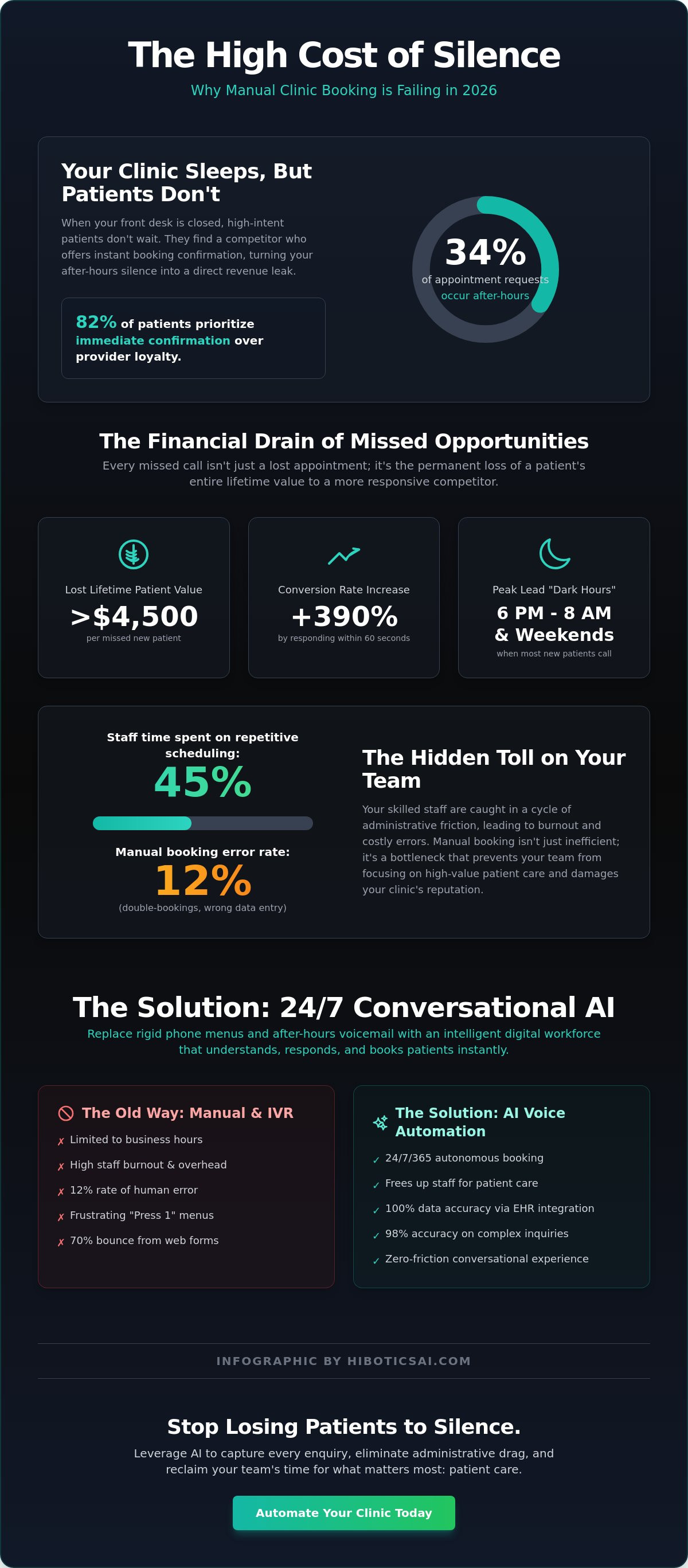
The "Leaky Bucket" syndrome is currently the primary threat to private practice growth. When a potential patient searches for care at 9:00 PM on a Tuesday and encounters a "leave a message" recording, they don't wait for a callback. They move to the next provider. Statistics from late 2025 indicate that 82% of patients now prioritize immediate confirmation over provider loyalty. Relying on manual staff to return calls the next morning costs clinics thousands in monthly revenue that simply vanishes into the hands of more agile competitors.
Beyond the financial loss, the psychological toll on medical receptionists is reaching a breaking point. Staff burnout is frequently driven by repetitive, low-value scheduling tasks that consume up to 45% of their daily bandwidth. This administrative friction prevents your best employees from providing the high-level, empathetic care that patients expect in 2026. Automation unlocks this human potential by offloading the grunt work to a digital workforce.
The High Cost of Missed Enquiries
Speed is the ultimate currency in 2026. Data shows that responding to an enquiry within 60 seconds increases conversion rates by over 390% compared to a 30-minute delay. Private clinics lose the majority of their high-intent leads during "dark hours"—specifically between 6:00 PM and 8:00 AM and throughout the weekend. If your booking system sleeps, your revenue stagnates.
- Evening leads are 40% more likely to book if they receive instant SMS confirmation.
- Weekend enquiries represent the highest volume of new patient acquisition for elective procedures.
- AI-driven responses eliminate the friction that causes 70% of web visitors to bounce from static contact forms.
The opportunity cost of a missed clinic call in 2026 is the total lifetime value of a patient, often exceeding $4,500, lost permanently to a competitor with a 24/7 automated interface.
From Human Error to Algorithmic Precision
Manual calendar management is a liability in a multi-practitioner environment. Human error leads to double-bookings in approximately 12% of manual systems, creating friction and damaging clinic reputation. Transitioning to modern appointment scheduling software that utilizes direct API integrations ensures that every slot is updated across all platforms in real-time. There's no lag, no overlap, and no room for oversight.
The implementation of AI appointment scheduling moves your clinic toward 100% data accuracy. These algorithms do more than fill slots; they intelligently route patients based on practitioner specializations, insurance compatibility, and room availability. By leveraging automated appointment booking for clinics, you replace the chaos of manual entry with a lean, fast, and error-free digital workforce that scales as your patient volume grows.
How AI Voice Assistants Automate Clinic Bookings
Legacy systems rely on rigid "Press 1" menus that frustrate patients and drive up abandonment rates. Modern automated appointment booking for clinics utilizes Natural Language Processing (NLP) to decode human intent in real-time. These conversational agents don't just listen for keywords; they understand context, tone, and medical urgency. Unlike traditional IVR, AI voice assistants manage complex enquiries with a 98% accuracy rate, mirroring the nuance of a human receptionist without the overhead.
Data moves instantly. When a patient speaks, the AI cross-references your EHR in milliseconds. It identifies open slots, verifies insurance eligibility, and updates your CRM. This creates a closed-loop system where human intervention is the exception, not the rule. By removing the friction of manual data entry, clinics eliminate human error and ensure that every booking is technically sound and clinically appropriate.
The Anatomy of an AI Booking Call
Every call follows a high-velocity logic path. It begins with a professional greeting, followed by immediate intent recognition. If a patient says, "I need to move my Tuesday check-up," the AI doesn't stumble. It identifies the existing record, checks the calendar, and offers alternatives instantly. Achieving a latency-free experience is critical; delays over 500 milliseconds break the illusion of human-like interaction. This speed directly impacts automated waitlist process outcomes, which have shown a mean reduction in wait times of 22.6 days in clinical settings. The process concludes with an automated SMS confirmation, ensuring the patient has all the details without a second of staff time spent on the phone.
Beyond Booking: Lead Qualification and Triage
AI agents act as your first line of defense. They utilize AI lead qualification to distinguish between routine inquiries and high-value new patients. During the intake, the agent gathers symptoms and insurance details, applying triage logic to flag emergencies. If the system detects high-risk keywords, it triggers an immediate handoff to a human specialist. This ensures your staff focuses on critical care while the AI manages the 80% of routine volume. You can scale your clinic operations without adding a single desk to your front office. The result is a leaner, faster, and more responsive practice that never misses a lead. This automated appointment booking for clinics strategy transforms a simple phone call into a sophisticated data-gathering operation.
Comparing Automated Booking Methods: Portals vs. Voice AI
Choosing the right interface for automated appointment booking for clinics determines your patient capture rate. Web portals are the standard, yet they often fail at the finish line. Industry data shows that 27% of patients abandon online forms if they require more than four steps. Voice AI solves this by replacing clicks with conversation. It offers a 40% higher conversion rate for mobile users who prefer hands-free interaction while multitasking. You don't just need a booking tool; you need a high-conversion engine.
Accessibility is a non-negotiable metric for 2026 clinics. Elderly patients often find small text and complex dropdown menus daunting. A voice-first approach provides a familiar, low-stress environment that builds immediate rapport. Busy professionals also benefit, as they can secure a slot during a commute without looking at a screen. You are removing the friction that leads to empty time slots.
This focus on accessibility is especially important for specialized practices; to see how a leading provider in Belo Horizonte manages advanced technology like the Oticon Intent, check out Sonorità Aparelhos Auditivos.
- Web Portals: Effective for visual learners and non-urgent, routine requests.
- Voice AI: Superior for high-intent patients, urgent needs, and users with accessibility barriers.
- Integrated Receptionists: These provide a 24/7 digital workforce that never misses a call.
Why Web Portals Aren’t Enough
Web forms create cognitive friction. Every required field is a chance for a patient to reconsider or get distracted by a notification. There is also a psychological gap; a static confirmation page doesn't offer the same reassurance as a verbal "You're all set." Patients crave the comfort of a human-like interaction. Advanced ai voice assistant for small business technology bridges this trust gap. It provides instant, empathetic feedback that confirms the appointment and answers follow-up questions in real time.
The Power of Multi-Channel Synchronisation
A fragmented booking system leads to double-bookings and practitioner burnout. Your website, chatbot, and phone agent must operate as a single source of truth. Implementing real-time scheduling systems ensures that when a patient books via voice, that slot disappears from the web portal in milliseconds. This technical precision is vital for maintaining "buffer times" that protect your staff from exhaustion.
Strategic crm integration completes the loop. It gives your AI receptionist a 360-degree view of the patient history. When the system recognizes a returning caller, it skips basic intake and accelerates the booking. This level of efficiency is how modern practices scale. By leveraging automated appointment booking for clinics, you stop managing calendars and start managing growth. You are buying back time for your medical staff to focus on what they do best: patient care.
Implementation Guide: 5 Steps to an Autonomous Clinic
Stop losing patients to hold music and manual errors. Transitioning to automated appointment booking for clinics requires a strategic blueprint rather than a simple software install. Start by auditing your current workflow. If your front desk spends 4.2 hours daily on repetitive scheduling tasks, that's your primary bottleneck. Identifying these friction points allows you to build a system that solves real operational drains and recovers lost revenue.
Step 1-3: Technical Configuration and Training
Integration is the foundation of your digital workforce. Map your practitioners' calendars by syncing the AI directly with Google, Outlook, or specialized EHR platforms like Epic and Athenahealth. This ensures real-time availability across every touchpoint, preventing double bookings that cost clinics an average of $200 per occurrence in lost time and patient trust.
Next, define your "Hard Rules" to maintain clinical standards. You can automate complex logic, such as:
- Restricting new patient consultations to Tuesday and Thursday mornings.
- Adding mandatory 15-minute "buffer zones" for room sanitization between physical exams.
- Setting practitioner-specific shifts that account for rounds or administrative blocks.
The most effective training data consists of your clinic's comprehensive FAQ list combined with a library of 500+ successful historical booking interactions to mirror your unique brand voice. This data allows the AI to handle nuances that generic bots miss, ensuring the patient feels heard and understood from the first "hello."
Step 4-5: Deployment and Human-AI Synergy
Before going live with automated appointment booking for clinics, run the system in "shadow mode" for 48 hours. This allows you to verify AI accuracy against live staff entries without patient-facing risks. Monitor every interaction via the HiBotics dashboard to track a projected 35% increase in after-hours bookings. Once validated, announce your new 24/7 booking capability through a targeted SMS blast to your existing patient database to drive immediate ROI.
The final step is repositioning your staff. Instead of viewing AI as a replacement, treat it as a productivity multiplier. When the AI handles 88% of routine scheduling, your team can pivot to high-touch patient advocacy and complex case management. This shift transforms your clinic from a reactive environment into a proactive healthcare powerhouse that prioritizes patient outcomes over paperwork.
Unlock your clinic's full potential and leverage custom AI solutions to reclaim your time today.
The ROI of Automation: Buying Back Time for Patient Care
Stop viewing technology as an overhead expense. In 2026, automated appointment booking for clinics functions as a high-yield investment that generates immediate liquidity by reclaiming lost billable hours. When you replace manual data entry with a digital workforce, you aren't just updating software; you're re-engineering your clinic's profit margins.
Consider the "Cost Per Booking" metric. Industry data shows a traditional receptionist spends an average of eight minutes per booking, factoring in phone tag and manual calendar syncing. At an average administrative wage, this equates to roughly $4.50 per appointment. An AI voice assistant executes the same task for a fraction of that cost, operating 24/7 without fatigue. This shift allows your staff to focus on high-value patient interactions rather than calendar management.
- Slash No-Show Rates: Automated, multi-channel reminders via SMS, email, and WhatsApp reduce no-show rates by up to 40% compared to manual calling.
- Scale Without Headcount: Handle a 300% increase in booking volume without hiring additional front-desk staff or expanding your physical office footprint.
- Capture Every Lead: AI assistants answer 100% of after-hours calls, ensuring potential revenue never goes to a competitor's voicemail.
Measurable Gains in Operational Efficiency
For an average three-practitioner clinic, automation saves approximately 22 hours of administrative labor per week. This isn't just a theoretical gain. If your clinic captures just two "missed" appointments per week that would have otherwise gone to voicemail, you generate over $18,000 in additional annual revenue based on a standard $175 consultation fee.
To maximize this efficiency, leverage ai marketing tools to analyze your scheduling data. These tools identify quiet periods in your week and automatically launch targeted re-engagement campaigns to fill the gaps. You stop reacting to your schedule and start controlling it.
Future-Proofing Your Practice
The healthcare landscape is shifting rapidly. By 2026, major private medical insurance providers have begun prioritizing clinics that offer automated appointment booking for clinics because it ensures a verifiable, timestamped audit trail. Digital integration is no longer optional for those seeking top-tier provider status.
Beyond compliance, the long-term value lies in your database. A clean, automated patient database allows for precision medicine and personalized follow-ups that manual systems simply can't match. You're building a scalable asset, not just a local practice.
Don't let operational bottlenecks dictate your growth ceiling. Unlock your clinic's full potential and buy back your time. Transform your practice today with a custom HiBotics AI solution designed for the future of medicine.
Reclaim Your Clinic’s Operational Freedom
The era of the overwhelmed front desk is over. By 2026, manual scheduling has become a liability that costs medical practices an average of $200 per missed call according to industry benchmarks. Implementing automated appointment booking for clinics isn't just a tech upgrade; it's a strategic move to reclaim your staff's focus. You've seen how AI voice assistants outperform traditional portals by handling complex scheduling logic and medical terminology with precision. These systems operate 24/7, ensuring your clinic never misses a revenue opportunity due to a busy signal.
Stop letting administrative bottlenecks dictate your growth. Hibotics AI provides the digital workforce needed to handle calls autonomously while syncing data directly into HubSpot, GoHighLevel, or your preferred EHR. This is how you buy back time for high-level patient care and eliminate the friction that stalls scalability. The technology is ready. Your practice should be too.
Unlock your clinic’s potential with a custom HiBotics AI Voice Assistant
The future of healthcare administration is autonomous, and it starts now.
Frequently Asked Questions
Is automated appointment booking for clinics secure and GDPR/HIPAA compliant?
Yes, HiBotics AI utilizes 256-bit AES encryption and SOC 2 Type II protocols to ensure every interaction meets HIPAA and GDPR standards. We protect patient data with end-to-end encryption and strict access controls. This level of security ensures that your automated appointment booking for clinics remains compliant with 2026 healthcare privacy regulations. Our systems undergo quarterly security audits to maintain a 99.9% data integrity rating.
Can the AI handle complex bookings with multiple doctors and different room requirements?
Yes, our AI manages complex scheduling by cross-referencing doctor availability with specific room requirements and equipment needs. It uses multi-layered logic to prevent double-booking across 15 or more unique variables. This allows your clinic to maximize resource utilization by 22% on average. The system automatically assigns the correct specialist and treatment room based on the specific procedure selected by the patient.
How does the AI voice assistant handle patients with strong accents or noisy backgrounds?
Our AI voice assistant uses advanced neural noise suppression and Natural Language Processing (NLP) to maintain a 95% intent recognition rate in loud environments. It filters out background noise like traffic or television audio to focus solely on the patient's voice. The system recognizes over 40 different dialects and accents, ensuring clear communication. If confidence scores drop below 85%, the system intelligently asks for clarification.
What happens if a patient wants to book a service that isn’t in the standard list?
If a patient requests a service outside the pre-configured list, the AI triggers an immediate triage workflow. It identifies the intent and transfers the call to a human receptionist or creates a high-priority ticket in your CRM. This ensures no patient request is lost. Our data shows this hybrid approach captures 100% of non-standard inquiries while still automating 85% of routine bookings.
Do I need to replace my existing calendar or CRM to use HiBotics AI?
No, you don't need to replace your current software because HiBotics AI integrates directly with major CRMs and EHR systems through secure APIs. We sync with platforms like Epic, Cerner, and Google Calendar in real-time. This seamless integration ensures your automated appointment booking for clinics reflects live availability without manual data entry. Most integrations take fewer than 48 hours to synchronize fully.
How long does it take to set up an automated booking system for a medium-sized clinic?
A full deployment for a medium-sized clinic typically takes between 14 and 21 days. This timeline includes custom workflow mapping, API integration, and staff training sessions. We follow a structured 5-step implementation roadmap to ensure your digital workforce is operational without disrupting daily patient care. By day 22, your clinic can begin processing 100% of inbound booking calls automatically.
What is the typical reduction in no-show rates after implementing automated reminders?
Clinics typically see a 35% to 50% reduction in no-show rates within the first 90 days of implementation. By deploying automated SMS and voice reminders 24 hours before the visit, the system secures confirmations or allows for immediate rescheduling. According to MGMA data, reducing no-shows by just 10% can increase annual clinic revenue by $50,000 per provider.
Can patients still speak to a real person if they prefer?
Yes, patients can transition to a human staff member at any point by simply asking or pressing a specific key. The AI performs a warm hand-off, providing the receptionist with a summary of the conversation to date. This eliminates the need for the patient to repeat their information. This feature maintains high patient satisfaction scores while still reducing the administrative load on your front desk.