

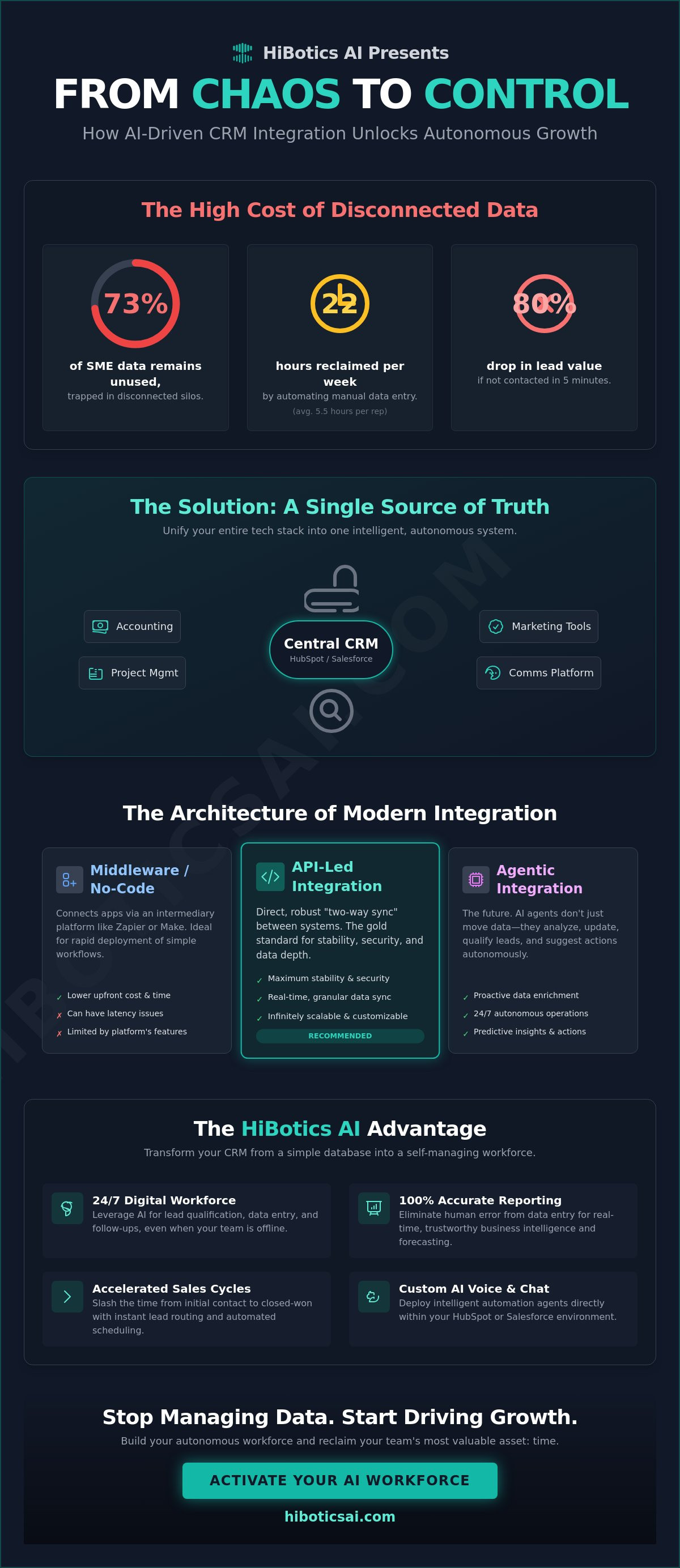
What if you could reclaim 22 hours of your staff's work week by turning your CRM into an autonomous growth engine? You likely already feel the friction of fragmented systems where leads fall through the cracks and manual data entry destroys your profit margins. It's a common bottleneck; industry research indicates that 73% of SME data remains entirely unused because it's trapped in disconnected silos. You know your team is capable of more, but they're currently buried in administrative debt.
This guide transforms that operational anxiety into a strategic advantage. You will learn how to master crm integration to unify your data sources and deploy AI-driven tools that automate your entire workflow for maximum scalability. We're moving beyond simple syncing to help you build a digital workforce that manages itself. We will outline the exact framework to create a seamless, real-time sales pipeline that ensures your reporting is 100% accurate and your growth is no longer limited by human bandwidth.
Key Takeaways
- Establish a "Single Source of Truth" by bridging the gap between your CRM and third-party tools for total data visibility.
- Master the architecture of modern crm integration to create a seamless digital handshake between your business systems and AI agents.
- Deploy a 24/7 digital workforce that leverages AI lead qualification to accelerate your sales cycle and drive autonomous growth.
- Audit your current tech stack and define precise data flows to eliminate operational bottlenecks and maximize scalability.
- Transform your HubSpot or Salesforce environment into an autonomous workforce with custom AI voice and chat automation.
What is CRM Integration and Why Does it Matter in 2026?
CRM integration is the digital bridge connecting your central database to your entire third-party application stack. It's the end of departmental silos. By linking your Customer relationship management platform with marketing, accounting, and communication tools, you create a Single Source of Truth. This ensures every team member accesses the same real-time data, eliminating the friction of conflicting information. In 2026, this isn't a luxury; it's the baseline for operational survival.
The shift from manual data syncing to AI-driven automation has redefined business velocity. High-growth SMEs no longer waste time on "batch updates" or weekly exports. Instead, they leverage crm integration to trigger instant workflows. When lead data flows immediately into your salesforce pipeline, your conversion rates climb. You stop reacting to the market and start anticipating it. This seamless flow directly impacts ROI by cutting the time between initial contact and closed-won status.
The High Cost of Fragmented Data
Data silos are the silent killers of SME growth. When leads remain trapped in disconnected spreadsheets or buried in personal email threads, your revenue suffers. The statistics are clear. Sales representatives lose an average of 5.5 hours per week to manual data entry and administrative tasks. That's over 280 hours per year of lost selling time per rep. Fragmentation also leads to "lead decay." A lead's value drops by 80% if you don't respond within five minutes. Without a unified system, meeting that window is impossible. You don't just lose the lead; you lose the marketing spend used to acquire it.
The 2026 Integration Landscape
Modern integration has moved far beyond simple webhooks. We've entered the era of deep API connections and "Agentic Integration." In this new landscape, AI agents don't just move data; they proactively update records, verify contact details, and suggest the next best action for sales teams. SMEs are now prioritizing crm integration to compete with global enterprises. They use these custom AI solutions to gain agility that larger, legacy-bound competitors can't match. Success in 2026 requires a tech stack that thinks and acts as one cohesive unit. It's about buying back your team's time and focusing their energy on high-value strategy rather than data plumbing.
- Real-time Accuracy: Zero lag between customer action and CRM update.
- Predictive Capability: AI-driven insights based on integrated data points.
- Scalability: Systems that expand automatically as your lead volume grows.
The Architecture of Modern Integration: From APIs to AI Agents
Architecture dictates speed. High-growth SMEs cannot afford fragmented data or manual entry. Your crm integration strategy rests on three primary pillars: native connections, middleware platforms, and custom API development. Each choice impacts your long-term scalability and bottom-line ROI. Selecting the wrong framework creates technical debt that slows down your digital workforce.
API-Led Integration: The Gold Standard
Direct API connections provide the highest level of stability and data depth. They facilitate a robust "two-way sync," ensuring that a status update in your project management tool reflects instantly in your CRM. An API is a protocol that allows two software components to communicate using a set of definitions. This method avoids the latency issues common in lower-tier solutions. A 2024 MuleSoft report found that 81% of IT leaders say siloed data hinders digital transformation. Direct APIs eliminate these silos by creating a permanent, high-speed digital handshake between systems.
- Stability: Direct connections are less likely to break during software updates.
- Granularity: You can map specific, custom fields that generic tools might ignore.
- Security: Direct connections reduce the number of third-party "middlemen" handling your sensitive client data.
Middleware and No-Code Solutions
Tools like Zapier and Make have democratized automation. They allow non-technical business owners to build complex workflows without writing a single line of code. These platforms act as an intermediary bridge between tools that don't share a native connection. According to 2023 industry data, 94% of small business workers perform repetitive tasks that these tools could automate in under an hour.
The pros of middleware include rapid deployment and lower upfront costs. However, these systems can become "spaghetti code" if not managed strictly. Best practices for keeping workflows lean include:
- Monthly Audits: Review active "Zaps" to eliminate redundant triggers.
- Error Handling: Set up automated alerts to notify your team the moment a workflow fails.
- Naming Conventions: Use strict labeling for every step to ensure your technical debt remains manageable.
Native integrations are "plug-and-play" features built by the software vendors themselves. They're reliable but often lack the precision required for unique business models. High-performing teams often leverage custom AI solutions to bridge the gaps where standard off-the-shelf tools fail. This approach ensures your crm integration adapts to your specific operational DNA, rather than forcing your team to work around the limitations of the software.
Strategic Benefits: Why Integration is the Key to Scalability
Stop viewing your CRM as a static database. In 2026, it's the engine room for your digital workforce. This isn't just software; it's a team of AI agents operating 24/7 to drive your business forward. When you master crm integration, you unlock the ability to process thousands of data points every second. This infrastructure enables ai lead qualification at a scale that human teams simply can't match. You can handle 10x your current lead volume without hiring a single extra employee. Efficiency isn't just an upgrade. It's a total transformation of your operational capacity.
The scalability factor is simple. Automation removes the bottlenecks that kill growth. By integrating your tools, you replace manual data entry with autonomous workflows. This allows your human talent to focus on high-level strategy while the machines handle the heavy lifting. You're not just growing; you're evolving into a lean, high-output machine that delivers personalized experiences to every prospect, every time.
Unlocking 24/7 Sales and Support
Your business shouldn't sleep just because your staff does. Integrated ai voice assistants now communicate directly with your CRM. They answer calls, qualify prospects, and book meetings into your sales team's calendar in real-time. This eliminates the "speed to lead" gap entirely. Industry data shows that responding to a lead within 5 minutes increases conversion rates by 391 percent. Automation ensures your brand voice remains consistent across every touchpoint, from the first call to the final follow-up. Your human team receives instant notifications, allowing them to step in exactly when a high-value deal is ready for the final handshake.
Data-Driven Decision Making
Integration builds a 360-degree view of your customer journey. You no longer guess which marketing channels drive revenue. You see the exact path from the first click to the final invoice. This level of visibility improves sales forecasting accuracy by 25 percent on average. Beyond mere reporting, this data serves a higher purpose. You use your historical records to train and optimize your custom AI models. This creates a feedback loop where your crm integration ensures your system becomes smarter with every interaction. You're turning raw data into a predictive asset that fuels long-term, sustainable growth.
- Eliminate Silos: Connect marketing, sales, and support for a unified truth.
- Boost ROI: Reduce cost-per-acquisition by automating lead nurturing.
- Enhance Experience: Deliver data-rich interactions that make customers feel known.
How to Implement a CRM Integration Strategy in 5 Steps
Stop treating crm integration as a backend IT project. It's a front-line growth lever. Successful SMEs in 2026 follow a rigorous deployment framework to ensure their tech stack acts as a single, unified organism. Follow these five steps to eliminate data silos and accelerate your operational velocity.
- Step 1: Audit the Stack. List every tool your team touches. Research from 2024 indicates that the average mid-sized firm uses 75 different SaaS applications. Identify where data is manually entered twice or where leads "go dark" between systems.
- Step 2: Establish Data Hierarchy. Define your "Master" and "Slave" systems. Your CRM should typically serve as the single source of truth. Data flows from marketing tools into the CRM, while billing systems pull data out.
- Step 3: Select Your Method. Choose between native "out-of-the-box" connectors, iPaaS platforms like Make or Zapier, or custom API development. Balance your internal technical debt against the need for total workflow flexibility.
- Step 4: Execute a Pilot. Don't overhaul everything at once. Automate one high-impact workflow first, such as syncing new LinkedIn leads directly to your sales pipeline.
- Step 5: Monitor and Scale. Use 2026-ready monitoring tools to track sync health. Once the pilot achieves 99% accuracy, replicate the logic across other departments.
Mapping Your Lead-to-Customer Journey
Identify the friction points where speed translates directly to revenue. High-growth firms prioritize the "speed to lead" metric. This is why ai appointment scheduling is the highest-ROI starting point for crm integration. It removes the 24-hour delay of manual back-and-forth emailing. However, you must avoid "Over-Automation." Use AI to handle the scheduling and data entry, but ensure a human expert steps in for the high-value discovery call. Automation should support your team, not replace the empathy required for closing complex deals.
Testing and Quality Assurance
Never deploy an integration directly into your live environment. Use a "Sandbox" or staging area to trigger workflows with dummy data. Industry benchmarks show that 18% of automated syncs fail due to field-mapping errors during the first week. Set up automated error alerts in Slack or Microsoft Teams to catch broken webhooks before they impact a prospect's experience. Commit to a monthly data cleansing ritual. Integrated systems amplify data quality; if you feed the system "dirty" data, you'll simply accelerate your errors at scale.
Ready to transform your operations with a digital workforce? Build your custom AI solutions with Hibotics AI today.
Connecting HiBotics AI: Turning Your CRM into an Autonomous Workforce
Stop treating your CRM as a digital filing cabinet. High-growth SMEs in 2026 understand that data is useless without immediate action. HiBotics AI functions as your dedicated integration specialist; we turn your static records into a proactive, autonomous workforce. We handle the heavy technical lifting required for deep crm integration, allowing your team to step away from the grind and focus on high-level strategy.
Our systems maintain seamless compatibility with industry leaders like HubSpot, Salesforce, and GoHighLevel. We don't just connect tools; we build intelligent bridges. When a lead enters your system, our AI voice and chat agents engage within seconds, not hours. This speed is critical. Industry data indicates that firms contacting prospects within five minutes are 100 times more likely to connect and qualify them compared to those waiting 30 minutes. We ensure you never miss that window of opportunity.
Custom AI Solutions for Your Tech Stack
Generic automation creates friction. We take a different approach by implementing custom CRM mapping tailored to your specific sales cycle. Our engineers analyze your current workflows to ensure your ai marketing tools work in perfect harmony. We map every custom field and lead status so your data remains clean and actionable. This isn't a "set and forget" service. We provide ongoing support and optimization to keep your pipeline flowing as your business scales. By automating the repetitive qualification process, you buy back roughly 25% of your sales team's weekly capacity immediately.
Ready to Automate Your Growth?
The transition from manual operations to AI-driven efficiency happens faster than you think. We specialize in rapid deployment, often completing a full crm integration and voice agent setup in under 14 days. You don't need to hire a new department to manage this technology; you just need the right partner to install it. Experience the future of SME operations by viewing a live demo of our autonomous voice agents in action. Take the first step toward reclaiming your time and accelerating your ROI.
Book your free AI Automation Audit with HiBotics AI today and transform your CRM into a self-sustaining revenue engine.
Future-Proof Your Operations with Autonomous Workflows
The era of manual data silos is over. By 2026, high-growth SMEs will rely on autonomous systems to maintain a competitive edge. Effective crm integration transforms your database from a passive record-keeper into a proactive revenue driver. You've learned how to leverage AI agents and API architecture to reclaim 30% of your team's weekly bandwidth. This isn't just about saving time; it's about building a foundation for limitless expansion.
HiBotics AI specializes in turning these strategic frameworks into high-velocity results. We provide seamless integration with HubSpot, GHL, and Salesforce to ensure your tech stack operates as a single, unified organism. Our experts deploy custom API workflows in as little as 14 days, removing the technical friction that stalls most digital transformations. You don't have to wait months for a smarter business; you just need the right architecture.
Unlock your business scalability with a HiBotics AI Integration Audit
The future of your industry is autonomous. Start building it today.
Frequently Asked Questions
What is the most common challenge in CRM integration?
Data silos represent the primary obstacle, with 81% of IT leaders reporting that fragmented information hinders digital transformation efforts according to MuleSoft’s 2024 Connectivity Benchmark Report. Teams often struggle with inconsistent data formats between legacy systems and modern platforms. You must establish a unified data protocol to prevent these bottlenecks. This ensures your crm integration remains accurate and actionable across all departments.
How much does it typically cost to integrate a CRM with AI tools?
Mid-market enterprises typically allocate between $10,000 and $50,000 for initial AI integration projects according to 2024 Gartner research. These figures cover API configuration and data mapping for standard high-growth environments. Your final investment depends on the complexity of your custom AI solutions and the volume of data processed. Higher complexity integrations often deliver a faster ROI by automating 40% of manual data entry tasks.
Can I integrate my CRM without hiring a full-time developer?
You can achieve seamless results using low-code platforms like Zapier or Make, which now power over 500,000 business automations globally. These tools allow your existing team to connect systems through visual interfaces without writing a single line of code. While complex custom logic might require expert oversight, 70% of standard workflows are now manageable by tech-savvy operations managers. For businesses that prefer a fully managed approach to their technical environment, HJS Technology Ltd provides the expert managed services needed to keep these systems performing at their peak.
What is the difference between a native integration and an API integration?
Native integrations are "plug-and-play" features built directly into your CRM software by the vendor. These offer immediate setup but often lack the flexibility needed for specific business logic. In contrast, an API integration uses custom code to connect disparate systems for more granular control. To see how expert developers build these bespoke solutions, you can learn more about API Pilot. API methods allow you to leverage 100% of your data points, whereas native options might limit you to basic contact syncs.
Will integrating AI tools with my CRM slow down my system performance?
Modern AI integrations use asynchronous processing to ensure your CRM speed remains unaffected by background computations. Research from 2025 indicates that cloud-based API calls typically execute in under 200 milliseconds, which is imperceptible to the end user. By offloading heavy data processing to external AI engines, you maintain a lightning-fast interface. This architecture allows your team to work at peak efficiency while the AI handles the heavy lifting.
How does CRM integration improve lead qualification?
Integration improves lead qualification by syncing real-time behavioral data with predictive scoring models. Companies using integrated AI lead scoring have seen a 20% increase in sales productivity as of 2024 studies. By connecting your marketing automation and CRM, you ensure every lead is ranked based on 50 unique intent signals. This eliminates manual guesswork and allows your sales team to focus exclusively on high-conversion opportunities.
Which CRM platforms are best for AI tool integration in 2026?
Salesforce and HubSpot remain the leaders for crm integration in 2026 due to their robust API ecosystems and open architectures. Salesforce currently supports over 5,000 third-party apps, while HubSpot’s App Marketplace grew by 35% in the last year. Microsoft Dynamics 365 is also a top contender for businesses heavily invested in the Azure ecosystem. These platforms provide the necessary infrastructure to scale your digital workforce without hitting technical ceilings.
Is my data secure when using third-party integration tools?
Data security is guaranteed when you select tools that maintain SOC2 Type II compliance and 256-bit AES encryption. Leading integration platforms currently boast 99.99% uptime and rigorous end-to-end encryption protocols to protect sensitive customer information. You should verify that any third-party tool complies with the 2018 GDPR regulations and the CCPA. Implementing a zero-trust architecture further ensures your proprietary data remains shielded from external vulnerabilities during the sync process.