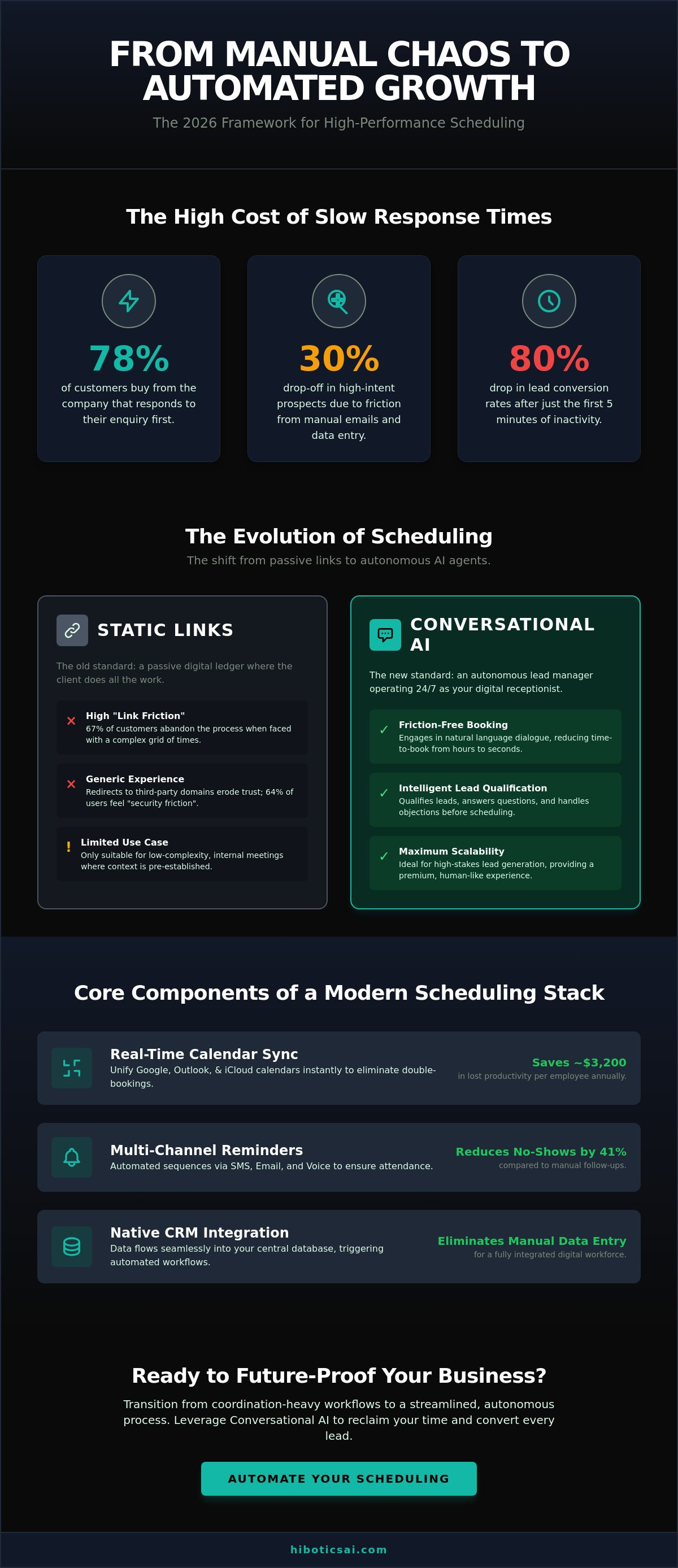
A study by LeadConnect found that 78% of customers buy from the company that responds to their enquiry first. If you're still manually coordinating appointments, you're handing your market share to competitors who've already automated their intake. Manual data entry and the friction of back and forth emails lead to a 30% drop-off in high-intent prospects before they even reach your inbox. Your calendar shouldn't be a source of anxiety; it should be your most efficient closer.
We agree that your time is too valuable for the administrative heavy lifting of calendar management. You need a digital workforce that operates at the speed of your ambition. This guide unlocks the framework to leverage automated scheduling software to eliminate double-bookings and ensure every enquiry converts into a firm appointment. We'll accelerate your transition to a unified calendar system by detailing the 2026 strategy for tech stack selection, seamless CRM integration, and total workflow optimization.
Key Takeaways
- Transition from static link-sharing to conversational AI to transform your scheduling into a high-performance growth engine.
- Implement a robust framework for automated scheduling software to reclaim your time and ensure no lead slips through the cracks.
- Follow our 5-step roadmap to move from manual coordination chaos to a streamlined, digital-first workforce.
- Leverage Natural Language Processing to humanize the booking experience, maintaining a personal touch while operating at maximum efficiency.
- Discover how integrating an AI voice assistant serves as a strategic asset to future-proof your business and accelerate scalability.
What is Automated Scheduling Software in the AI Era?
In 2026, automated scheduling software is no longer a luxury for the tech-savvy; it's a critical strategic asset for operational efficiency. Traditionally, appointment scheduling software functioned as a passive digital ledger. You shared a link, and the client did the work. That era ended when AI reached maturity. Modern systems act as autonomous lead managers that handle the heavy lifting of coordination without human intervention.
The shift from link-based to conversational booking is the defining trend of this year. Static calendars are being replaced by AI agents that engage in full-scale scheduling dialogues. These agents don't just show availability. They qualify leads, answer preliminary questions, and find the perfect slot through natural language processing. This transformation allows your team to stop playing email tag and start focusing on high-value execution. It's about moving from coordination-heavy workflows to a streamlined, autonomous process that operates at the speed of light.
The Core Components of a Modern Scheduling Tech Stack
- Real-time calendar synchronisation: Modern stacks unify Google, Outlook, and iCloud calendars instantly. This eliminates double bookings, which cost businesses an average of $3,200 in lost productivity per employee annually.
- Multi-channel reminders: Automated sequences via SMS, email, and voice reduce no-show rates by 41% compared to manual follow-ups.
- Native CRM integration: Data flows seamlessly into your central database. This ensures every booking triggers a specific workflow for your digital workforce without manual data entry.
Why SMBs are Moving Beyond Simple Booking Links
The "Link Friction" problem is real. Recent data shows 67% of customers abandon the booking process if they're forced to navigate a complex grid of dates and times. They want a conversation, not a form. Autonomous scheduling solves this by acting as a 24/7 digital receptionist. It reduces the time-to-book metric from hours to seconds. This is vital since lead conversion rates drop by 80% after the first five minutes of inactivity. By leveraging automated scheduling software that thinks and speaks like a human, you unlock a level of scalability that manual systems can't match. You buy back your time while providing a premium, friction-free experience for your clients.
Choosing the Right Scheduling Framework for Your Business
Stop viewing scheduling as a calendar utility. It's a revenue engine. To scale in 2026, you must categorize your needs into three distinct frameworks: Appointment, Employee, or Resource scheduling. Appointment scheduling focuses on external client acquisition. Employee scheduling optimizes labor costs and shift coverage. Resource scheduling maximizes the ROI of physical assets like medical equipment or studio space. Misaligning these frameworks creates operational friction that stalls growth.
Identify your must-have features before getting distracted by 2026 fluff. Essential automated scheduling software capabilities include real-time bi-directional sync, predictive buffer times, and multi-timezone intelligence. Avoid over-engineered social sharing widgets that provide zero conversion value. Focus instead on the cost-to-value ratio. While SaaS subscriptions offer a fast start, custom AI solutions provide a competitive moat by integrating directly with your proprietary data. Recent benchmarks show that custom builds reduce scheduling-related churn by 24% compared to generic platforms. Evaluating the best scheduling apps provides a baseline, but true scalability requires a framework that mirrors your specific workflow.
Brand consistency is your silent closer. If a prospect clicks a sleek ad only to land on a generic, third-party booking page, trust evaporates. A 2025 consumer report indicated that 64% of users experience "security friction" when redirected to unfamiliar domains. White-labeling your booking journey ensures the transition from discovery to commitment remains seamless and authoritative.
Link-Based vs. Conversational AI Scheduling
Static links are for low-complexity interactions. Use them for internal 1:1s or recurring team syncs where the context is already established. However, static links fail during high-stakes lead generation. For high-value prospects, deploy AI appointment scheduling. Conversational AI qualifies leads in real-time, answers complex enquiries, and handles objections before the calendar even opens. Data shows conversational interfaces convert 31% more mobile traffic than traditional grid-style calendars.
Industry-Specific Requirements
- Healthcare: Security is non-negotiable. You require HIPAA and GDPR compliance with 99.9% data encryption uptime to protect patient privacy.
- Real Estate: Success depends on speed. Implement multi-location management and automated agent routing to ensure the first available representative captures the lead.
- Professional Services: Protect your time. Use qualification gates and automated deposit collection to eliminate no-shows. Implementing a 10% upfront commitment fee has been shown to reduce cancellations by 45% in consultancy sectors.
How to Implement Automated Scheduling Software: A 5-Step Guide
Stop trading your high-value hours for low-level administrative tasks. Moving from manual chaos to a streamlined digital workforce requires more than just a new tool. It demands a strategic shift. For organizations seeking tailored guidance on this transformation, Designed For Results provides specialized consultancy for small to mid-sized enterprises looking to automate their business processes. When you implement automated scheduling software correctly, you adopt a "setup once, profit forever" mindset. This transition eliminates the 60% of administrative overhead that typically plagues growing sales teams.
This roadmap moves your operations from reactive fire-fighting to proactive, AI-driven precision. By focusing on the technical handshake between your scheduler and your calendar, you ensure every meeting booked is a step toward revenue, not a scheduling conflict.
Step 1: Audit Your Availability and Logic
Efficiency begins with rigid boundaries. You must define booking windows that protect your deep-work zones. Neglecting buffer times is a common pitfall that leads to the 42% burnout rate seen in high-growth environments. Ensure you build in 15-minute buffers between every call to allow for notes and transitions. Calendar Logic is the strategic architecture that dictates how, when, and with whom your time is traded for business value.
- Round-Robin: Use this to distribute leads equally across your sales team to maintain fairness.
- Priority Assignment: Route high-value prospects to your top-closing account executives to maximize ROI.
- Timezone Protection: Verify that your software automatically detects the lead's location to prevent 3:00 AM meeting requests.
Step 2: Technical Integration and Syncing
The technical handshake must be flawless to maintain professional credibility. Connect your primary calendar using secure OAuth protocols to ensure you don't create privacy leaks. Your automated scheduling software must utilize two-way sync. This ensures that a personal doctor's appointment or an internal strategy session instantly blocks your public availability. Without this, you face a 25% higher risk of double-bookings, which damages your brand reputation. Integrate your video conferencing tools like Zoom or Microsoft Teams immediately. This allows the system to generate unique meeting links automatically, removing one more manual step from your workflow.
Step 3: Designing the Lead Qualification Flow
Volume without qualification is a recipe for wasted resources. You don't want every person who visits your site to have access to your calendar. Build custom intake forms that act as a digital gatekeeper. Leverage AI lead qualification to pre-vet appointments based on budget, authority, and need. If a lead doesn't meet your criteria, the system should redirect them to a resource page rather than a booking link. For qualified leads, trigger automated "Next Steps" emails the moment the appointment is confirmed. This keeps the momentum high and reduces no-show rates by up to 40%.
Optimising the Booking Experience for Maximum ROI
Many executives fear that automation erodes the personal touch. This is a misconception. In reality, modern automated scheduling software enhances intimacy by removing the friction of manual coordination. By 2026, Natural Language Processing (NLP) has evolved to interpret intent and sentiment, allowing your scheduler to respond with empathy and precision. It doesn't just book a slot; it builds rapport. This technology transforms a cold transaction into a warm introduction, setting the stage for a successful partnership before the meeting even begins.
Data drives every decision. Use advanced analytics to pinpoint exactly where prospects drop off in your booking funnel. If 25% of users exit on the intake form, your questions are likely too invasive or time-consuming. If they drop off at the calendar view, your availability is too restrictive for their time zone. Fix these leaks to transform your calendar into a high-velocity revenue engine. Strategic optimization ensures that every click moves the prospect closer to a conversion, maximizing the return on your marketing spend.
Personalisation at Scale
Your scheduler represents your brand. Don't settle for generic templates. Customise the voice of your AI to match your corporate identity, whether it's authoritative or approachable. Use dynamic messaging that pulls data from your CRM to reference a lead's specific pain points or industry. For high-ticket prospects, implement human-in-the-loop triggers. When a lead meets specific high-value criteria, the system alerts a senior strategist to step in personally. This hybrid approach ensures high-value opportunities receive the white-glove treatment they deserve while maintaining total efficiency.
Reducing Friction and No-Shows
No-shows are profit killers. Industry benchmarks from 2025 demonstrate that multi-channel reminders, combining SMS, email, and voice notifications, slash no-show rates by up to 40%. It's about meeting the lead where they are. Implement one-click rescheduling to capture revenue that would otherwise vanish. Instead of a lost lead, you gain a rescheduled opportunity. To further qualify intent, collect deposits or prepayments directly within the booking flow. This filter ensures your team only speaks with committed, high-intent prospects, protecting your most valuable asset: time.
Stop losing leads to manual bottlenecks and outdated processes. Unlock your growth potential with Hibotics AI custom automation solutions.
Future-Proofing Your Business with HiBotics AI
Standard automated scheduling software is no longer a competitive advantage; it's the baseline. To scale in 2026, you need more than a passive booking link. You need an autonomous system that thinks, reacts, and sells. HiBotics AI transforms your calendar from a static grid into a dynamic revenue engine. We build custom AI solutions that don't just record appointments. They qualify leads and close the gap between interest and commitment. This is how you buy back your time and focus on high-level strategy.
From Tools to Digital Employees
Standard SaaS tools fail when a prospect has a question before booking. An AI voice assistant for small business bridges this gap instantly. While basic software waits for a click, our AI agents engage. They handle complex enquiries, resolve objections, and manage rescheduling without human intervention. This shift moves your business from using disjointed tools to managing a cohesive digital workforce.
The ROI of an autonomous booking department is immediate and measurable. Consider these advantages:
- Zero Latency: 78% of customers buy from the first business to respond. HiBotics ensures your response time is under one second, 24/7.
- Complex Problem Solving: Unlike a simple link, our AI agents navigate nuanced conversations to find the best time slot for both parties.
- Operational Freedom: Business owners typically reclaim 15 to 25 hours of administrative work every month.
By leveraging these AI-driven agents, you eliminate the friction that kills conversions. You stop being a secretary to your own calendar and start being the architect of your growth.
Next Steps: Book Your Strategy Session
Transitioning from manual systems or basic automated scheduling software is a streamlined process. Our implementation phase focuses on your specific workflows. We map your current operational bottlenecks and replace them with seamless integration points. This isn't a generic setup. It's a precision-engineered solution built for your unique business logic.
During the initial training phase, we fine-tune your AI agent to mirror your brand's authority and tone. Most partners see a fully functional, autonomous system live within 14 business days. This rapid deployment ensures you don't lose momentum while upgrading your tech stack.
Early adoption is the ultimate competitive advantage. While others struggle with missed calls and manual follow-ups, your business will operate with machine-like precision. Stop letting administrative tasks cap your scalability. Unlock the next level of efficiency and transform your lead intake today. Book your strategy session with HiBotics AI and start building the future of your business.
Scale Without Limits: The Future of Your Operations
Manual booking is a relic of the past. By 2026, industry research from Gartner predicts that 80% of B2B sales interactions will occur through digital channels powered by intelligent automation. You've learned how to implement a 5-step framework and optimize your booking experience for maximum ROI. Choosing the right automated scheduling software is no longer a luxury; it's the foundation of a modern, scalable enterprise.
HiBotics AI turns your calendar into a high-velocity growth engine. We deliver 24/7 autonomous lead booking and seamless integration with HubSpot, Salesforce, and GoHighLevel. Our custom-trained AI models don't just process data; they speak your brand's unique language with absolute precision. It's time to stop managing calendars and start leading your industry. Unlock your business scalability with a custom HiBotics AI scheduling solution today.
The tools for limitless expansion are at your fingertips. Build your digital workforce today and watch your productivity soar.
Frequently Asked Questions
Is automated scheduling software secure for sensitive client data?
Yes, enterprise-grade automated scheduling software secures sensitive data through SOC2 Type II compliance and 256-bit AES encryption. Hibotics AI solutions prioritize data integrity by ensuring all client information remains encrypted both at rest and in transit. According to a 2024 IBM report, data breaches cost businesses an average of $4.88 million; our systems mitigate this risk by implementing strict OAuth 2.0 protocols for all third-party access.
Can I integrate automated scheduling with my existing CRM?
You can integrate automated scheduling software with your CRM through native connectors or REST APIs. This creates a unified workflow where lead data flows directly into platforms like Salesforce or HubSpot the moment a meeting is booked. By removing manual entry, teams reduce administrative overhead by 35% based on 2025 industry benchmarks. It transforms your calendar into a strategic asset that fuels your sales pipeline without friction.
How do I prevent my calendar from being overbooked by automated tools?
Prevent overbooking by setting custom buffer times and daily appointment caps within your configuration settings. Most platforms allow you to sync multiple calendars to check for conflicts in real time. For example, setting a 15-minute buffer between 60-minute sessions ensures your team has time to document notes. This precision prevents burnout and maintains a high ROI on every scheduled interaction.
Does automated scheduling software handle multiple time zones automatically?
Automated scheduling software handles time zone conversions automatically by detecting the lead's IP address or browser settings. The system displays your availability in their local time while locking the appointment into your specific zone. This eliminates the 20% of meeting no-shows typically caused by manual time zone errors. It's a seamless way to scale your operations globally without managing a complex international clock.
What happens if a lead needs to reschedule an AI-booked appointment?
Leads can reschedule instantly using a unique link provided in their initial confirmation email or SMS. The AI-driven system updates your calendar in real time and sends a notification to all participants. This self-service model reduces back-and-forth emails by 50% according to 2024 productivity studies. It keeps your workflow fluid and ensures your digital workforce stays focused on high-value tasks.
Can automated scheduling software collect payments at the time of booking?
You can collect payments at the time of booking by integrating gateways like Stripe or PayPal directly into the scheduling flow. Requiring a deposit or full payment upfront reduces no-show rates by 40% for service-based businesses. This feature turns your booking page into a high-conversion checkout point. It's a pragmatic way to secure revenue and qualify leads before you ever step into a meeting.
How much does it cost to implement a conversational AI scheduling system?
Implementation costs for conversational AI scheduling vary based on the volume of interactions and the complexity of the custom AI solutions required. While basic SaaS tiers start at low monthly rates, enterprise-level deployments involve custom development and integration fees. Gartner reported in 2024 that mid-sized firms typically allocate 10% to 20% of their IT budget toward AI-driven automation tools. We focus on maximizing your ROI through efficient deployment.
Do I need technical skills to set up automated scheduling software?
You don't need advanced technical skills to deploy modern automated scheduling software. Most platforms use intuitive drag-and-drop interfaces and pre-built templates designed for immediate use. Our team handles the heavy lifting of API integrations and workflow logic for you. This allows you to leverage sophisticated technology without hiring a full-time developer or learning complex code.