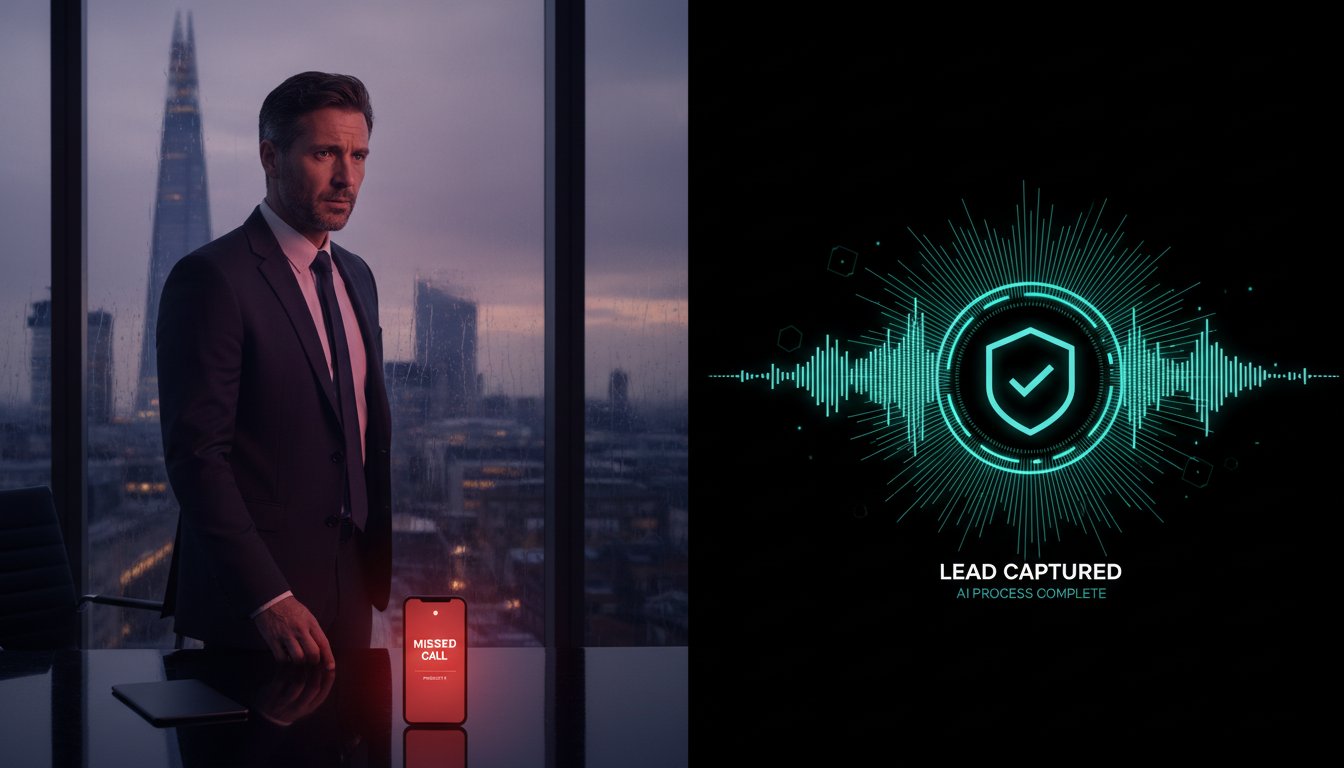

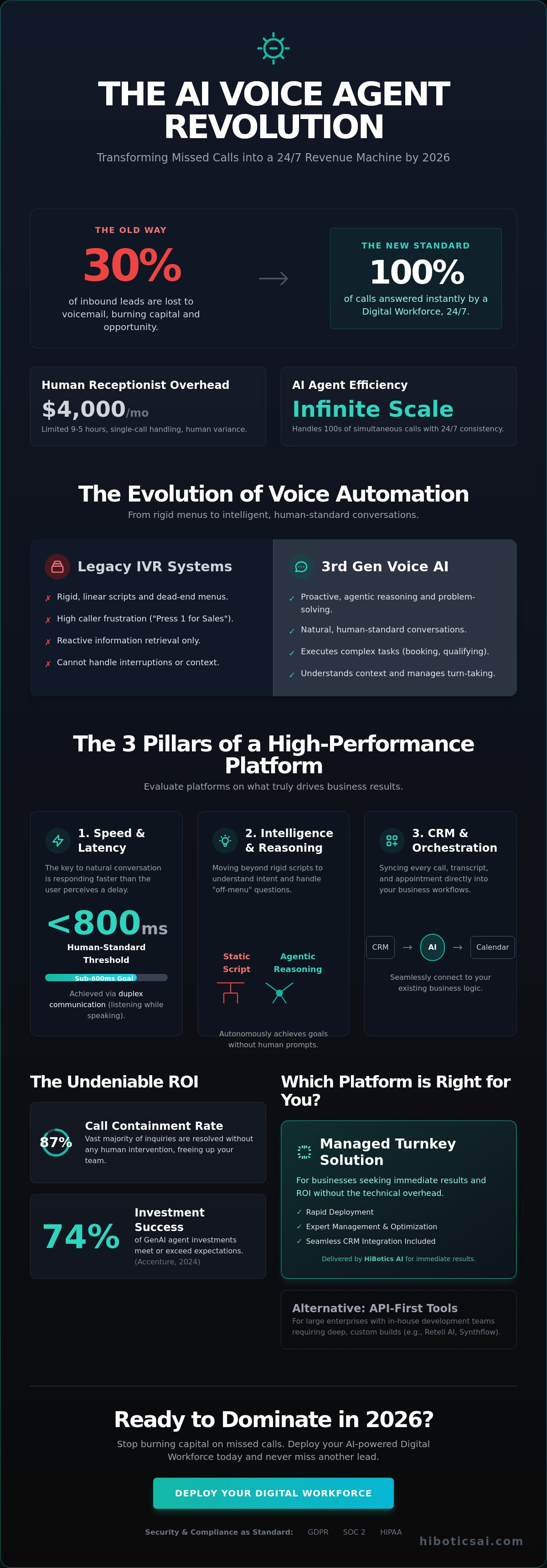
If you're still losing 30% of your inbound leads to a voicemail box, you aren't just missing calls; you're burning capital. In 2026, the competitive edge belongs to the business that answers every dial instantly with human-standard precision. Choosing the right ai voice agent platform is no longer a technical experiment. It's a strategic move to deploy a digital workforce that scales infinitely without the $4,000 monthly overhead of a human receptionist.
You likely realize that traditional IVR systems are dead and your customers demand immediate, intelligent interaction. We'll help you navigate this shift by showing you how to evaluate, compare, and deploy a system that buys back your time while maintaining sub-800ms latency. You'll learn how to transform your operations from a bottleneck of missed opportunities into a 24/7 revenue machine.
This guide breaks down the pricing models of leaders like Retell AI and Synthflow, explores the ROI of 87% call containment rates, and provides a blueprint for seamless CRM orchestration. We're moving past the "pretty voice" and focusing on the robust business logic required to dominate your market in 2026.
Key Takeaways
- Transition from rigid, legacy IVR systems to 3rd Gen Voice AI capable of handling natural, human-standard conversations.
- Evaluate any ai voice agent platform based on the three pillars of performance, specifically sub-800ms latency and agentic reasoning.
- Decide between API-first tools for custom development or managed, turnkey solutions from HiBotics AI that deliver immediate results.
- Unlock seamless CRM orchestration by syncing every call transcript and appointment directly into your existing business workflows.
- Adopt a "Digital Workforce" strategy to scale your call volume infinitely and buy back your time without increasing human headcount.
What is an AI Voice Agent Platform in 2026?
An ai voice agent platform is a sophisticated, unified ecosystem designed to replace the friction of human-to-computer interaction with the fluid grace of natural speech. It isn't a single tool. It is the high-speed orchestration of three critical layers: ultra-fast Speech-to-Text (STT), Large Language Model (LLM) reasoning, and high-fidelity Text-to-Speech (TTS). In technical terms, it functions as what is an intelligent agent; it perceives its auditory environment and takes autonomous actions to achieve specific business goals without human prompts.
The era of "Press 1 for Sales" is officially over. Traditional Interactive Voice Response (IVR) systems were reactive and rigid, frustrating callers with dead-end menus. By contrast, 3rd Gen Voice AI represents a shift toward proactive digital employees. These agents don't just follow a script. They understand context, handle interruptions, and execute complex workflows like booking appointments or qualifying leads in real-time. They are the frontline of your digital workforce, designed to execute tasks rather than just provide information.
The Evolution of Voice Automation
We've moved from touch-tone menus to agents powered by advanced LLMs that process intent faster than a human brain. In 2026, the industry standard for response time has dropped below 600ms. This "Human-Standard" latency is the threshold where the "uncanny valley" disappears. When your AI responds this quickly, the caller stops thinking about the technology and starts focusing on the solution. Modern platforms also leverage emotional intelligence. They adjust tone and pacing based on the caller's sentiment to build immediate rapport and trust.
Why SMEs are Migrating to Autonomous Platforms
Small and medium enterprises in the UK are currently facing a "Voicemail Gap." Data shows that 30% of leads are lost to unanswered calls or voicemail boxes. This isn't just an inconvenience; it's a direct hit to the bottom line. An autonomous ai voice agent platform allows a business to scale instantly. You can handle 100 simultaneous calls at 3:00 AM with the same level of precision as a single call at noon. You gain the capacity of a massive call center without the $4,000 monthly overhead per human agent.
The ROI is undeniable. A 2024 Accenture report highlighted that 74% of generative AI agent investments meet or exceed expectations. By 2026, SMEs are using these platforms to achieve 80% to 87% call containment rates. This means the vast majority of inquiries are resolved without human intervention. This allows your core team to focus on high-value strategy rather than routine scheduling. Consistency is the final piece of the puzzle. Every customer receives the same high-level service, 24/7, without the fatigue or variance inherent in human staffing.
The 3 Pillars of a High-Performance AI Voice Platform
Technical specs often mask the true goal of automation. A high-performance ai voice agent platform isn't just a collection of cool features; it's a strategic asset designed to generate ROI. While many providers focus on the "realism" of the voice, the market leaders in 2026 differentiate themselves through robust business logic and orchestration. We evaluate these systems using an AI Voice Agent Platform Evaluation Matrix that prioritizes speed, intelligence, and integration over mere novelty.
Security remains the foundation of this infrastructure. Your platform must handle sensitive customer data with absolute precision. As of the January 30, 2026 regulatory updates, compliance with GDPR, SOC 2, and HIPAA is the bare minimum requirement. Every interaction must be encrypted and every transcript securely logged to protect both your business and your clients.
Latency and Natural Turn-Taking
Customer trust is fragile. If your AI takes longer than 800ms to respond, the conversation feels disjointed and robotic. The "latency stack" includes the time required for transcription, LLM processing, and audio synthesis. Premium agents achieve sub-600ms response times to mirror human speech patterns. This fluid interaction relies on duplex communication, which is the ability for an AI to listen and process new input while simultaneously speaking. If a customer interrupts to change their mind, the AI must stop instantly and pivot without losing the thread of the conversation.
Reasoning vs. Scripts
Static scripts are the relics of old IVR systems. They fail the moment a customer asks an "off-menu" question or provides an unexpected answer. Modern ai voice agent platform technology utilizes agentic reasoning to handle edge cases autonomously. Instead of scanning for simple keywords, the system understands the nuances of human intent. This capability is essential for sophisticated AI lead qualification. The agent can determine if a prospect is a "hot lead" based on the context of their pain points, not just because they said a specific word. It allows the AI to act as a sharp-witted strategist on your behalf.
Data orchestration is the final pillar. A conversation is only valuable if the results are actionable. High-performance platforms move data between the call and your CRM in real-time. Whether it's updating a lead score in HubSpot or syncing a booking to Google Calendar, the automation should feel invisible and instantaneous. If you want to see these pillars in action for your own business, consider how custom AI solutions can replace your operational bottlenecks with limitless scalability.
Managed vs. API-First Platforms: Which is Right for You?
Deploying an ai voice agent platform in 2026 involves a high-stakes trade-off. You're either buying a technical toolkit for your developers or a finished outcome for your business. The market has matured into two distinct paths. API-first solutions offer raw power for engineers, while managed models provide a streamlined digital workforce for owners who prioritize speed over technical tinkering.
API-first providers like Retell or Bland.ai offer usage rates between $0.05 and $0.15 per minute. While these entry costs look attractive on a spreadsheet, they often ignore the reality of technical maintenance. For a non-technical founder, the DIY route quickly becomes a second job. You'll find yourself managing prompt versions and troubleshooting integration breaks instead of closing deals. If your goal is to buy back your time, spending your weekends debugging API calls is a step in the wrong direction.
Managed platforms treat AI as a strategic asset rather than a project. You aren't just paying for the minutes; you're paying for the expertise required to ensure that voice converts callers into customers. With 74% of generative AI agent investments meeting or exceeding expectations this year, the real winners are those who prioritize rapid deployment and reliability over technical experimentation.
When to Choose a DIY API Stack
Opt for an API-first stack if you have a dedicated in-house engineering team and require 100% granular control over the model's architecture. This is the correct choice if you're building a standalone software product where the voice agent is your primary intellectual property. It's for those who enjoy the complexity of building custom "Make.com" workflows and have the bandwidth to manage daily technical updates as LLM models evolve.
The HiBotics AI Managed Advantage
HiBotics AI provides the "heavy lifting" so you can focus on high-level growth. We don't just give you access to an ai voice agent platform; we engineer the entire solution from training the model to syncing your specific business logic. This managed approach ensures your AI evolves alongside your company without requiring you to learn a single line of code. We handle the custom implementation and ongoing optimization that production-grade AI requires.
Our team treats your automation as a strategic asset that must perform consistently every single day. We ensure your digital worker stays sharp, handling everything from FAQ responses to complex lead qualification with human-standard precision. For a detailed look at how this managed model transforms front-desk operations, read The strategic guide to AI receptionists. We deliver the result so you can reclaim your focus immediately.
Implementation: Connecting AI Voice to Your Business Logic
A sophisticated ai voice agent platform is only as valuable as the data it can access. If your agent can't "see" your calendar or "read" your CRM, it's just a glorified chatbot. In 2026, the gold standard for implementation is built on Function Calling. This capability allows the AI to pause a conversation, query your backend database in real-time, and deliver a factual answer based on live data. It transforms a simple interaction into a high-utility transaction.
The "Hand-off" protocol is equally critical for maintaining customer trust. While enterprise-grade solutions achieve call containment rates between 80% and 87%, the remaining calls require a human touch. Your platform must support seamless transfers. When the AI detects a complex edge case or high emotional distress, it should route the call to your team along with a live transcript and sentiment summary. This ensures your human staff never enters a conversation cold.
Success depends on orchestration. You aren't just installing software; you're deploying a digital employee that needs to know its boundaries and its tools. To see how these systems integrate with your specific business goals, explore our custom AI solutions today.
From Call to Calendar
Stop playing the "email tag" game to book a single consultation. Automated appointment booking allows your AI to check real-time availability and secure a slot instantly. For medical clinics or professional service firms, this removes the friction that often kills a lead's momentum. We define real-time availability sync as the essential bridge between a spoken request and a confirmed calendar event. For specialized industries, our guide on AI appointment scheduling provides a blueprint for autonomous booking in 2026.
The Unified Sales Pipeline
Your ai voice agent platform should act as a data entry specialist that never sleeps. Through deep CRM integration, every call transcript, lead score, and sentiment tag flows directly into HubSpot or GoHighLevel. This creates a closed-loop marketing system where every dial is tracked and analyzed. By automating these workflows, businesses typically reduce manual data entry for sales teams by 90%. You move from guessing about lead quality to having a unified, data-driven pipeline that accelerates your ROI. This level of orchestration ensures that your digital workforce isn't just talking; it's driving measurable growth.
Strategic Selection: Why HiBotics AI is Your 2026 Partner
Choosing an ai voice agent platform shouldn't feel like a technical chore. It should feel like a strategic breakthrough. While many providers offer a cold API key and a "good luck" message, HiBotics AI operates as a high-level growth partner. We recognize that business owners don't want to manage software; they want to buy back their time. Our focus remains fixed on delivering a specific result: a 24/7 autonomous operation that converts leads while you focus on high-level strategy.
We build our services on a "Digital Workforce" philosophy. This isn't about replacing people. It's about scaling your business without the traditional friction of increasing headcount. When you leverage our custom AI solutions, you deploy an asset that handles 100 simultaneous calls with the same precision as a single interaction. You eliminate the $4,000 monthly overhead of a human receptionist and replace it with a system that costs 10% to 30% of a full-time salary. We ensure your technology acts as a profit center, not a cost center.
Beyond the Software: The Partnership Model
The AI landscape moves fast. A model that leads the market in January 2026 might be surpassed by June. SMEs need a partner who can navigate these rapid shifts and optimize their ai voice agent platform in real-time. We handle the constant "tuning" of your agents to ensure they maintain human-standard quality as your business evolves. Our commitment is to your operational efficiency. For a deeper look at how this fits your growth plan, explore our guide on the AI voice assistant for small business. We take care of the underlying code so you can take care of your customers.
Ready to Automate Your Front Desk?
Stop letting 30% of your leads vanish into voicemail. The future of your business is 24/7 availability, zero missed opportunities, and seamless CRM orchestration. You've seen the data: 87% call containment rates and 90% reductions in manual data entry are the new standards for success. It's time to move from consideration to implementation and secure your competitive edge in a crowded market.
We invite you to book a discovery call with HiBotics AI today. During this session, we'll perform a custom lead qualification audit for your business. We'll identify your current operational bottlenecks and show you exactly how a digital workforce can accelerate your ROI. Don't just watch the future happen; build it with a partner who is as invested in your growth as you are.
Secure Your Competitive Edge in 2026
The transition from rigid menus to autonomous digital workers is the defining operational shift of this decade. By now, you understand that the right ai voice agent platform isn't just about a realistic voice. It's about achieving sub-800ms latency and 87% call containment rates. It's about replacing the 30% lead loss gap with a system that never sleeps and never misses a detail. You have the blueprint to transform your operations from a series of bottlenecks into a high-speed revenue engine.
You can choose the technical debt of a DIY API stack or the pragmatic efficiency of a managed partnership. Scaling your business requires moving beyond manual data entry and embracing the 90% workflow automation possible through deep CRM orchestration. Stop managing administrative friction and start leveraging a digital workforce that expands your capacity without increasing your headcount. The future belongs to those who automate with precision.
Ready to transform your front office? Scale your business with a custom AI Voice Agent from HiBotics AI. Benefit from 24/7 Lead Capture, Zero Latency Conversational AI, and Seamless HubSpot/Salesforce Integration. Your journey toward limitless scalability starts today.
Frequently Asked Questions
What is the difference between an AI voice agent and an IVR system?
An AI voice agent uses natural language processing to understand intent; whereas an IVR system relies on rigid, pre-recorded menus and button presses. In 2026, agents handle open-ended questions and interruptions with ease. This replaces the frustration of "Press 1" with fluid, human-standard conversation. It allows callers to speak naturally and get instant resolutions. This technology functions as an intelligent layer that understands context rather than just recognizing simple keywords.
How much does an AI voice agent platform cost for a small business?
Usage-based platforms typically cost between $0.05 and $0.15 per minute. For a business handling 5,000 to 10,000 minutes monthly, expect a budget between $350 and $1,200. Some providers like Bland.ai offer a fixed rate of $0.09 per minute. These costs represent about 10% to 30% of the expense of hiring a human receptionist. Selecting the right ai voice agent platform ensures you only pay for the minutes you actually use while scaling your capacity.
Can an AI voice agent really sound like a human in 2026?
Yes, modern agents achieve human-standard quality by maintaining response times below 600ms. This speed eliminates the awkward pauses that used to signal a robotic presence. Advanced synthesis models now incorporate emotional intelligence and natural breathing patterns. Customers often can't distinguish between a high-end AI agent and a human operator. This level of realism builds immediate trust and ensures a professional brand image during every single interaction, 24/7.
Do I need a developer to set up an AI voice agent platform?
You only need a developer if you choose an API-first platform like Vapi or Retell. These tools require technical expertise to build the business logic and manage complex automation workflows. Conversely, managed providers handle the entire setup and training process for you. This "turnkey" model is designed for business owners who want a result rather than a technical project. It allows you to deploy a digital worker without writing a single line of code.
Which CRM systems can AI voice agents integrate with?
Most 2026 platforms offer native integrations with HubSpot, GoHighLevel, Salesforce, and Pipedrive. They use secure webhooks to sync call transcripts and lead scores instantly. This connectivity ensures your sales pipeline stays updated without manual data entry. If you use a custom or legacy system, an ai voice agent platform can usually connect via a custom API bridge. This creates a unified data environment that accelerates your sales cycle and improves lead tracking.
Is my customer data safe with an AI voice agent platform?
Your data is protected by global standards including GDPR, HIPAA, and SOC 2. Leading platforms also maintain ISO 27001 certification and PCI-DSS compliance for handling credit card information. Every conversation is encrypted from end to end. These security protocols ensure that customer interactions remain private and your business stays compliant with current data regulations. Safety is a foundational requirement for any production-grade AI deployment to protect your brand's reputation.
What happens if the AI voice agent doesn't know the answer to a question?
The agent will trigger a seamless hand-off protocol to a human staff member. It doesn't just hang up; it transfers the call along with a live transcript and a summary of the conversation so far. This ensures your team can take over with full context. You can also configure the AI to offer a callback if your staff is currently unavailable. This prevents dead-ends and ensures every customer inquiry eventually reaches a satisfactory resolution.
Can an AI voice agent handle outbound sales calls as well as inbound?
Yes, these agents are highly effective for both inbound support and outbound lead qualification. For outbound calls, they must comply with TCPA regulations to ensure legal and ethical outreach. They excel at following up on web form submissions or confirming upcoming appointments instantly. By automating these repetitive tasks, you free up your human sales team to focus on high-ticket closing. This dual-capability maximizes the ROI of your digital workforce across all departments.