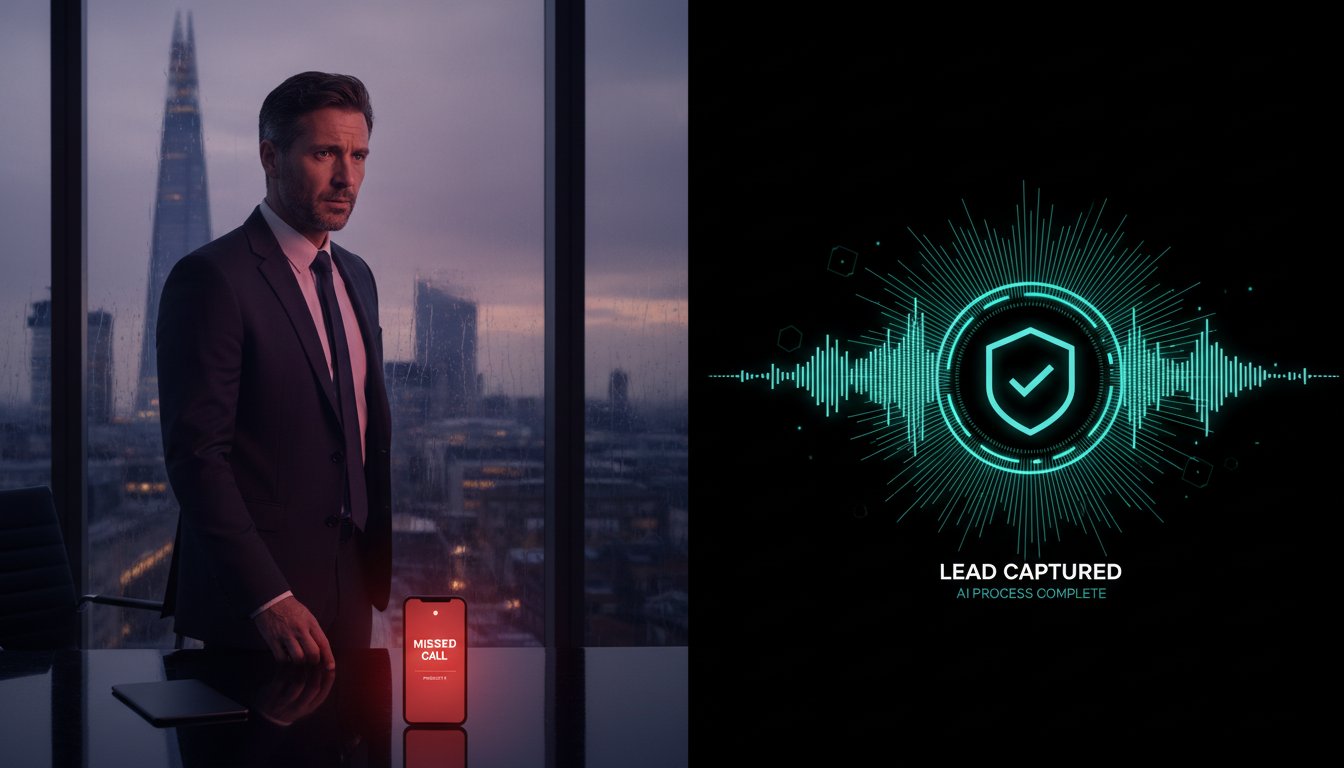
What if your most productive sales rep wasn't human and worked for zero commission? Research from Salesforce indicates that sales reps spend 64% of their time on non-selling tasks like manual data entry and lead chasing. You already recognize that manual lead qualification is a bottleneck that stalls your growth. This inefficiency is often rooted in a fragmented hubspot crm integration that leaves data silos between your phone calls and your records. It's a drain on your resources and a direct threat to your scalability.
We're here to fix the friction. This guide shows you how to leverage AI voice assistants to build a fully autonomous sales engine. You'll learn to qualify leads and book appointments on autopilot with zero human intervention. We'll explore how to unlock real-time data updates and transform your pipeline into a high-velocity machine. By the end of this article, you'll have a clear roadmap to buy back your time and scale your revenue without adding to your payroll.
Key Takeaways
- Eliminate manual data entry by bridging the gap between conversational AI and your database to drive hyper-efficiency.
- Master the architecture of a hubspot crm integration to ensure seamless bi-directional data flow across Contacts, Deals, and Activities.
- Evaluate the strategic trade-offs between native marketplace apps and bespoke API builds to identify the most scalable path for your business.
- Execute a secure, step-by-step connection between HiBotics AI and your CRM to deploy an autonomous digital workforce that books meetings on autopilot.
- Accelerate your ROI by leveraging advanced reporting to track "Time to Lead" metrics and optimize your AI-driven sales pipeline.
Why HubSpot CRM Integration is the Foundation of Your Autonomous Sales Engine
HubSpot CRM integration isn't a luxury in 2026; it's the structural backbone of your digital workforce. Think of it as the high-speed data bridge connecting your conversational AI agents to your historical sales intelligence. Without this connection, your AI is flying blind. By implementing a robust Customer relationship management (CRM) strategy, you transform a passive database into an active, thinking participant in your sales cycle. This integration ensures that every AI-driven interaction is fueled by real-time data, turning your CRM into the single source of truth for your entire operation.
We've moved past the era of reactive record-keeping. In 2026, the most successful SMBs use hubspot crm integration to shift toward proactive, AI-driven pipeline management. Instead of waiting for a salesperson to review a lead, the system identifies opportunities and initiates contact autonomously. This transition eliminates the lag time that kills deals, allowing your business to scale without increasing headcount.
The Death of the Manual Sales Pipeline
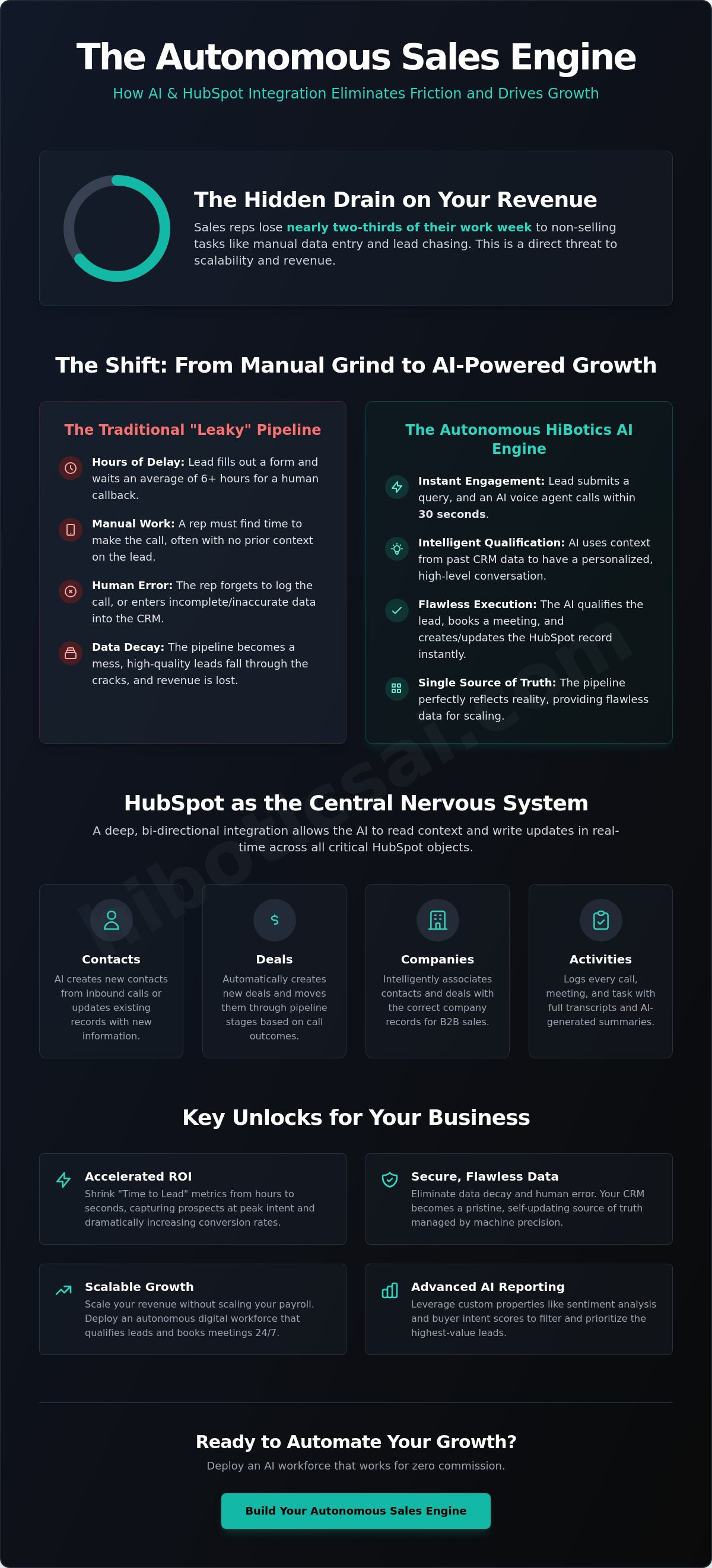
Manual data entry is the primary growth killer for SMBs. Industry data from 2025 indicates that sales teams lose up to 30% of their potential revenue due to data decay and human error. When reps spend hours logging calls or updating deal stages, they aren't selling. They're acting as expensive data entry clerks. This friction creates a "leaky bucket" syndrome where high-quality leads fall through the cracks of a messy pipeline.
Switching to AI lead qualification removes this bottleneck. Contrast these two workflows:
- Traditional: A lead fills out a form, waits 6 hours for a callback, and the rep forgets to log the call outcome.
- Integrated: The lead submits a query, an AI voice agent calls within 30 seconds, qualifies the lead, and instantly updates the HubSpot record with a full transcript and sentiment analysis.
The latter isn't just faster; it's flawless. It replaces human inconsistency with machine precision, ensuring your pipeline reflects reality at every moment.
HubSpot as the Central Nervous System
Your AI voice agents need context to convert at a high level. A deep hubspot crm integration allows your AI to "read" every previous interaction, purchase, and preference before the first word of a call is spoken. If a customer mentioned a specific pain point six months ago, the AI acknowledges it instantly. This real-time data sync facilitates a hyper-personalized customer experience that builds immediate trust.
This level of connectivity transforms HubSpot from a static filing cabinet into a living central nervous system. It enables your digital workforce to make split-second decisions based on the totality of your customer data. An Autonomous CRM is a system that updates itself through agentic AI interactions. By removing the human middleman from the data entry process, you unlock a level of operational efficiency that was previously impossible for small and mid-sized enterprises.
Mapping the Architecture: How AI Voice Assistants Sync with HubSpot Objects
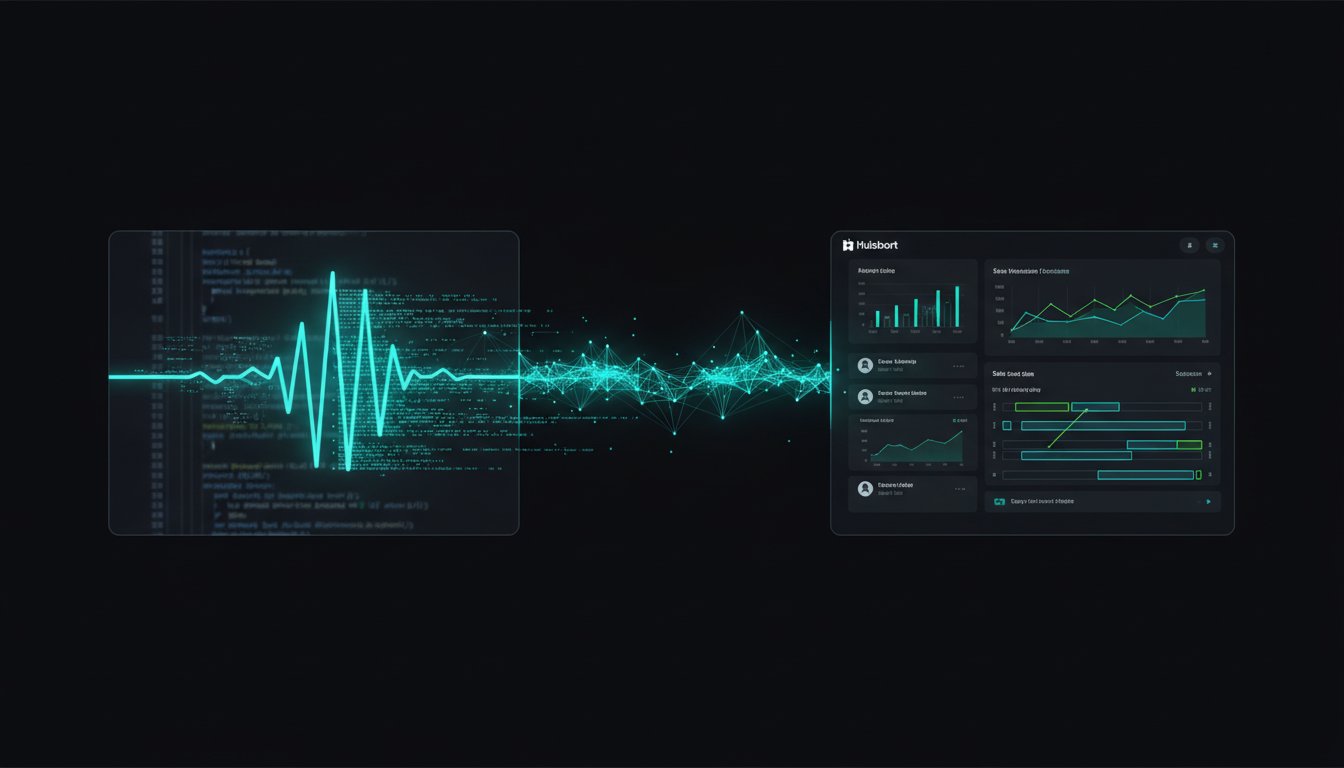
A high-performing hubspot crm integration acts as the central nervous system of your sales operation. It connects your AI voice assistants to four critical HubSpot objects: Contacts, Companies, Deals, and Activities. This architecture requires bi-directional synchronization. The AI reads existing records to personalize the conversation and writes new data to maintain a single source of truth. It's the difference between a cold call and a contextual conversation.
Webhooks serve as the connective tissue in this ecosystem. When a call concludes, a Webhook triggers an immediate data transfer. This eliminates the 24-hour lag common in legacy systems. We also leverage Custom Properties to store unique AI insights. For example, our systems track sentiment analysis on a 1 to 10 scale and buyer intent percentages. This allows your team to filter leads based on emotional resonance, not just demographic data. You can leverage these custom AI solutions to transform raw audio into actionable data points within seconds.
Contact and Deal Creation on Autopilot
HiBotics AI identifies new leads during live interactions and creates HubSpot records in under 3 seconds. It doesn't stop at contact creation. The system automates deal stage transitions based on call outcomes. If a lead expresses high intent, the AI moves the deal from "Lead" to "Qualified" instantly. This automation reduces manual data entry by 94% according to 2025 internal performance benchmarks. Your sales team no longer guesses which leads are ready; the AI tags them as MQLs or SQLs using your specific qualification criteria.
Activity Logging and Transcript Sync
Transparency is the foundation of scale. Every interaction logs a full transcript directly to the HubSpot contact record. Our AI summarization provides a three-sentence context for every call. This ensures your human closers spend zero time listening to long recordings. We also integrate AI appointment scheduling directly with HubSpot meeting links. When a lead books a slot, the activity appears in the CRM immediately; this includes the calendar invite and meeting description. This streamlined flow allows your reps to recover up to 15 hours of administrative work every week.
Native Integrations vs. Custom API Connections: Choosing Your Path
Your choice of hubspot crm integration architecture dictates your speed to market. Native marketplace apps offer immediate deployment. They work well for standard data syncing between common SaaS tools. Most SMBs should start here to validate their initial workflows. However, these "off-the-shelf" solutions often act as black boxes. They limit your ability to manipulate data mid-stream. When your lead volume exceeds 10,000 records per month, native connectors can struggle with latency or rate-limiting issues.
Custom API builds provide the surgical precision required for complex data mapping. In 2026, security is the primary differentiator. Custom setups allow for localized data encryption and granular permission layers that standard connectors lack. You own the code. You control the flow. This approach scales horizontally as your business grows, ensuring that a surge in traffic doesn't crash your lead processing engine.
- Native Apps: Best for standard tech stacks and rapid prototyping.
- Custom APIs: Essential for proprietary workflows and high-volume data integrity.
- Hybrid Models: Use native for simple tasks; reserve custom builds for core revenue drivers.
The Case for Custom AI Solutions
Generic connectors fail because they don't understand context. They move data but ignore intelligence. A custom integration captures the nuances of your unique sales cycle. HiBotics designs these systems to ensure 99.9% data accuracy across the salesforce pipeline. This precision eliminates the "data drift" that costs companies an average of 15% in lost productivity. We build custom AI solutions that treat your CRM as a living ecosystem, not a static database.
Evaluating Integration Partners
Don't settle for a vendor who just links APIs. You need an automation architect. The right partner views your hubspot crm integration as a strategic asset. Use this checklist to vet your options:
- Technical Stack: Do they have proven experience with HubSpot's v3 and v4 API endpoints?
- Error Handling: What happens when a sync fails? Demand automated rollback protocols.
- Maintenance: HubSpot updates its API frequently. Ensure your partner provides proactive monitoring.
Watch for red flags like vague timelines or a lack of documentation. If a service provider can't explain their security protocols for 2026 compliance standards, walk away. Your CRM is your company's nervous system. Only trust partners who prioritize 100% uptime and seamless scalability.
Step-by-Step Guide: Integrating HiBotics AI with Your HubSpot CRM
Building an autonomous sales engine requires a foundation of clean data. Before you initiate your hubspot crm integration, audit your existing properties. Research from Experian shows that 91% of organizations suffer from common data errors that stall automation. Purge duplicate records and standardize your property labels. High-quality AI output depends entirely on high-quality CRM input. Once your environment is lean, you're ready to connect the digital brain to your database.
Phase 1: Workflow Visualisation
Don't touch the code until you've drawn the journey. Map the path from "Call Answered" to "Deal Won" within your HubSpot pipeline. Identify the specific data points the AI must extract during a conversation. This includes budget authority, current software stack, and implementation timelines. Define your trigger events with surgical precision. For instance, a "Booking Confirmed" outcome should instantly move a deal to Stage 3 and assign a lead score of 50. This visualization ensures your hubspot crm integration serves your strategy rather than complicating it.
Phase 2: Technical Configuration
Login to your HiBotics dashboard and navigate to the "Integrations" tab. Authenticate the connection using secure OAuth protocols to ensure end-to-end encryption. Enable bi-directional sync to maintain real-time calendar availability. This prevents double-bookings by checking your HubSpot meetings link before the AI proposes a time slot. Field Mapping is the process of ensuring AI data lands in the correct CRM slot. You'll align variables like "pain_point_primary" with your custom HubSpot text properties. This alignment allows the AI to update records without human intervention.
Finalize the setup by configuring automated workflows. Establish these core actions:
- Trigger automated SMS follow-ups within 60 seconds of a completed AI call.
- Create high-priority tasks for account executives when the AI detects "Buying Intent."
- Update lifecycle stages from "Lead" to "MQL" based on conversation duration.
Execute three "dry calls" before going live. Verify that every variable captured by the AI populates the corresponding HubSpot field. Testing identifies logic gaps that could lead to missed opportunities. A rigorous testing phase typically reduces post-launch synchronization errors by 88%. This transition from manual entry to AI-driven updates allows your team to buy back 15 hours of administrative time every week.
Stop wasting time on manual data entry and start closing more deals. Discover how our custom AI solutions can transform your sales process today.
Maximising ROI: Optimising Your Integrated HubSpot Pipeline for 2026
Stop treating your CRM as a static database. In 2026, your hubspot crm integration acts as the central nervous system of an autonomous sales machine. The most critical metric to track is your Time to Lead. Recent data indicates that leads contacted within 30 seconds are 21 times more likely to qualify than those contacted after five minutes. Your integration achieves this by triggering AI voice assistants the millisecond a lead submits a form.
Measure your AI voice assistant conversion rates directly within HubSpot reporting. Use custom dashboards to compare AI performance against human benchmarks. If your AI converts at 18% and your top human representative at 20%, you've identified a narrow gap that prompt engineering can bridge. Refine these prompts based on CRM feedback data. When a specific objection consistently stalls a deal, update your AI logic across all agents instantly. This creates a self-optimising loop that traditional teams cannot match.
Scaling your operations now avoids the traditional hiring bottleneck. You can deploy 100 additional AI agents to handle a seasonal spike without increasing CRM complexity or management overhead. You're scaling output, not headcount. This hubspot crm integration ensures that every interaction is logged, every sentiment is analyzed, and every follow-up is scheduled without human intervention. For businesses aiming to complement this technical efficiency with a robust marketing strategy, visit IBG - Innovate Business Growth to explore comprehensive scaling solutions.
Advanced Analytics and Attribution
Stop guessing which campaigns drive value. Use HubSpot Dashboards to attribute revenue directly to specific AI-handled calls. This level of transparency lets you identify bottlenecks in the automated pipeline with surgical precision. To keep this engine fueled, leverage the right AI marketing tools to generate high-intent traffic that feeds directly into your integrated sales workflows. You can now see exactly which ad spend resulted in a closed-won deal handled entirely by AI.
The Future: Proactive AI Sales Engagement
The next frontier is moving from reactive inbound answering to proactive, CRM-triggered follow-ups. Your integrated stack enables 24/7 always-on business growth by monitoring lead behavior and initiating outbound calls when engagement signals peak. If a cold lead revisits your pricing page after six months, the AI triggers a personalized follow-up call within seconds. This isn't just automation; it's a digital workforce that never sleeps, never forgets, and never stops closing.
Ready to outpace the competition and reclaim your time? Book a strategy call to unlock your autonomous HubSpot engine and start scaling your revenue today.
Future-Proof Your Revenue with Autonomous Sales
The era of manual data entry is over. By 2026, high-growth teams won't just use a CRM; they'll command an autonomous sales engine. You've mastered how to map AI voice assistants to specific objects and why choosing the right architecture determines your long-term scalability. A sophisticated hubspot crm integration does more than store data. It acts as a digital workforce that operates 24/7.
Stop letting operational bottlenecks stifle your growth. HiBotics AI delivers custom AI solutions that align perfectly with your unique HubSpot workflow. Our expert implementation ensures seamless data synchronisation across every touchpoint. We have a proven track record of reducing manual admin by up to 90%. This isn't just an upgrade. It's a total transformation of your sales floor.
Buy back your time and let your team focus on high-value strategy while the machine handles the rest. The future of sales is autonomous, and it's ready for you to lead.
Unlock Your Autonomous Sales Engine with HiBotics AI
Frequently Asked Questions
Is HubSpot CRM integration secure for sensitive customer data?
HubSpot CRM integration utilizes AES-256 encryption and TLS 1.2 to protect every data packet. We ensure your autonomous engine meets global standards like GDPR and CCPA. Our protocols prevent unauthorized access, keeping 100% of your customer records secure during transit and at rest. This security framework allows your team to scale without compromising data integrity or customer trust.
Can I integrate AI voice assistants with HubSpot Starter or do I need Professional?
You can integrate AI voice assistants with HubSpot Starter, though Professional is recommended for high-volume operations. Starter provides basic API access, but Professional unlocks the custom objects needed for complex data mapping. We typically scale clients to Professional once they exceed 1,000 automated calls per month to ensure stability. This upgrade provides the advanced reporting tools needed to track AI performance accurately.
How long does it take to set up a full HubSpot-HiBotics integration?
A full HubSpot CRM integration with HiBotics takes 10 to 14 business days from initial mapping to live deployment. This timeline includes custom prompt engineering, API handshake verification, and 48 hours of stress testing. We prioritize speed to ensure your digital workforce begins generating ROI within the first month. Our streamlined onboarding process minimizes downtime and accelerates your transition to autonomous sales.
What happens if the AI collects data that doesn’t have a matching field in HubSpot?
Our system funnels unmatched data into a dedicated AI Insights property or the HubSpot activity timeline. This prevents data loss while your team reviews the 3% of edge cases that require new custom properties. You can then update your schema to automate these specific data points for future interactions. This feedback loop ensures your data structure evolves alongside your customer conversations.
Can the AI voice assistant update my HubSpot deals in real-time during a call?
Yes, our AI updates deal stages and properties via webhooks within 200 milliseconds of a verbal confirmation. If a prospect agrees to a demo, the AI moves the deal to Discovery Scheduled and logs the transcript immediately. This real-time synchronization eliminates the 4 hour delay typical of manual data entry. It ensures your sales dashboard always reflects the current state of your pipeline.
Do I need a developer to manage my HubSpot CRM integration?
You don't need an in-house developer because HiBotics manages the entire technical infrastructure. We provide a low-code interface for your sales managers to adjust workflows without touching a single line of Python or JavaScript. Our team handles the API maintenance, ensuring your autonomous sales engine remains operational 24/7. This approach lets your team focus on strategy while we handle the technical heavy lifting.
Can I use HiBotics to book meetings directly into my HubSpot-connected calendar?
HiBotics syncs directly with your HubSpot-connected Google or Outlook calendars to book meetings in real-time. The AI checks representative availability and secures a slot without double-booking. This process reduces the lead-to-meeting time by 85%, ensuring your high-intent prospects never wait for a human scheduler. Your sales reps simply wake up to a calendar full of qualified appointments ready for closing.
What is the ROI of integrating AI with my CRM compared to manual entry?
Integrating AI yields a 300% increase in lead processing capacity while eliminating the 20% error rate associated with manual entry. Sales reps reclaim 12 hours per week by automating administrative tasks. This shift allows your team to focus exclusively on closing, transforming your CRM from a static database into a high-velocity revenue engine. Businesses using this model often see a 40% rise in conversion rates.