

The traditional model of hiring a virtual assistant for small business is officially obsolete. While your competitors still struggle with unreliable talent, the 2026 strategic shift leverages a digital workforce that never sleeps and never misses a detail. Data from the Small Business Administration indicates the average founder loses 40% of their productive hours to administrative tasks that don't drive revenue. You've likely felt that drain as you spend 10 hours a week on repetitive scheduling or watch leads vanish because of a missed call.
We agree that your time is too valuable for manual data entry. This article promises to reveal how to integrate next-generation automation that eliminates operational bottlenecks and buys back your strategic freedom. You'll discover how to build a seamless customer experience and scale your lead qualification without adding to your payroll. We're diving into the exact workflows you need to transform your business into a high-speed, autonomous engine for growth.
Key Takeaways
- Shift from simple task-taking to a strategic digital workforce designed to unlock limitless scalability and operational efficiency.
- Compare the performance metrics of a modern virtual assistant for small business to choose the most cost-effective human, AI, or hybrid model.
- Identify high-impact, revenue-generating categories that transform your support system from a cost center into a high-speed ROI driver.
- Master the "Process First" integration roadmap to ensure seamless onboarding and immediate workflow optimization without the friction.
- Discover how custom AI solutions build a truly autonomous business engine that allows you to buy back your time and focus on growth.
Beyond Outsourcing: Defining the Modern Virtual Assistant for Small Business
The role of a virtual assistant for small business has undergone a radical transformation. It's no longer just a remote contractor performing basic administrative tasks. In 2026, the modern virtual assistant functions as a sophisticated, remote support system integrated into the core of your business operations. This evolution marks a shift from simple task execution to high-level strategic support. Business owners are moving away from the 2010s mindset of hiring a "helper" to building a digital infrastructure that drives growth.
A foundational understanding of What is a Virtual Assistant reveals a profession that started with human freelancers. Today, that definition includes autonomous systems capable of managing complex workflows. The 2026 market is relentless. It demands 24/7 availability and instantaneous response times. Human staff cannot maintain this pace without significant overhead and burnout. This reality forces a transition toward hybrid models where technology handles the heavy lifting.
The primary ROI metric for any modern business owner is no longer just "cost per hour." It's the concept of buying back time. When you deploy a virtual assistant for small business, you aren't just spending money to get tasks done. You're purchasing the freedom to focus on high-value revenue drivers. Every hour reclaimed from administrative friction is an hour invested in scaling your brand. Efficiency is the new currency.
The Evolution of Virtual Support
The journey from 2010s freelance marketplaces to 2026 autonomous digital workforces has been swift. Traditional hourly-rate human models are becoming obsolete for routine operations. Small businesses now prioritize consistency and scalability over manual labor. Implementing an ai virtual assistant allows SMEs to leverage enterprise-level power. These digital workers don't sleep, don't require benefits, and execute tasks with 100% accuracy. This shift empowers small teams to outperform much larger competitors.
Why Small Businesses Fail to Scale Without Support
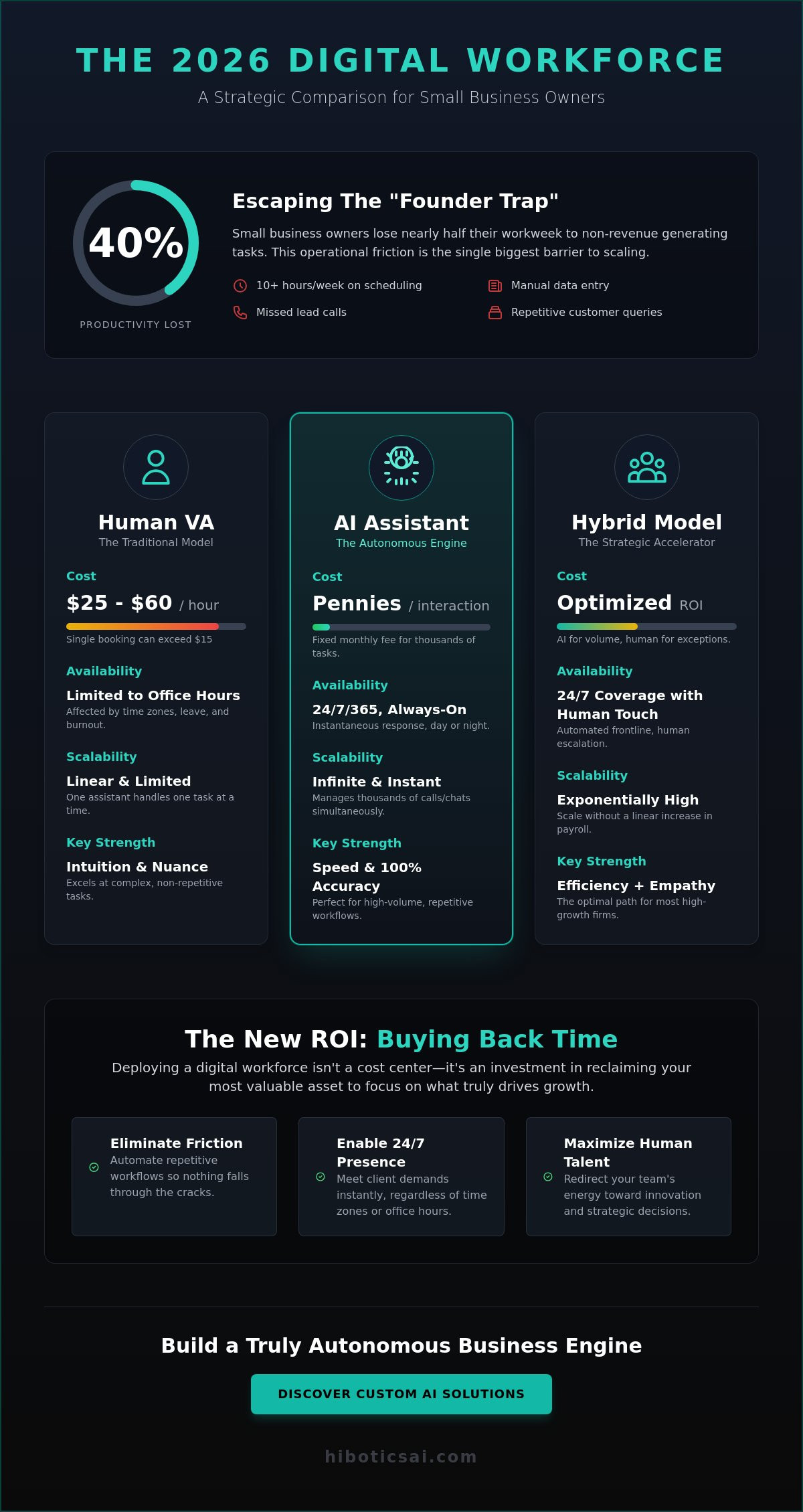
The "Founder Trap" is the most common cause of business stagnation. Research shows that small business owners spend up to 40% of their workday on non-core administrative tasks. This drains creativity and stalls revenue growth. You can't lead a company if you're stuck managing calendar invites and basic customer queries. Identifying these energy-draining tasks is the first step toward freedom. Virtual support acts as the bridge. It transforms a bottlenecked operation into a streamlined machine, providing the necessary foundation to transition from a small business to a full-scale enterprise.
- Eliminate Operational Friction: Automate repetitive workflows to ensure nothing falls through the cracks.
- Enable 24/7 Presence: Meet client demands instantly, regardless of time zones or office hours.
- Maximize Human Talent: Redirect your team's energy toward innovation and strategic decision-making.
Human, AI, or Hybrid? Choosing Your 2026 Digital Workforce
The choice between human talent and algorithmic efficiency defines your 2026 operational floor. Small businesses no longer view a virtual assistant for small business as a single job description; it's a strategic choice between three distinct models. Traditional human VAs offer deep intuition, while AI voice assistants provide infinite scale. If you are looking to discover Amplify Yourself, LLC, you can find high-quality human talent that serves as a perfect foundation for a hybrid approach. The hybrid model, however, is where most high-growth firms find their rhythm by using AI to handle the volume and humans to handle the nuance.
Cost-per-interaction remains the most aggressive differentiator. A skilled human assistant typically bills between $25 and $60 per hour. When you factor in management overhead and idle time, the cost of a single customer booking can exceed $15. AI subscription models invert this logic. For a fixed monthly fee, an AI assistant manages thousands of calls or chats simultaneously, reducing the cost-per-interaction to pennies. This allows you to scale your virtual assistant for small business strategy without a linear increase in payroll.
Reliability in 2026 is measured by the "Always-On" standard. Human assistants are bound by time zones, sleep cycles, and personal leave. AI never sleeps. It provides 24/7 availability, ensuring that a lead generated at 2:00 AM is qualified and booked by 2:01 AM. This instant responsiveness is critical; data from 2025 indicates that response times under 60 seconds increase conversion rates by 391% compared to delayed human follow-ups.
Traditional Human Virtual Assistants
Human VAs remain the gold standard for high-stakes relationship building and complex, non-linear creative projects. A traditional virtual assistant serves as a remote extension of your team, leveraging human intuition and emotional intelligence to manage nuanced professional relationships. While they offer unmatched empathy, they face challenges with limited bandwidth and higher operational costs. Understanding how a virtual assistant can make you more productive involves identifying which high-level tasks, such as strategic networking or complex project management, require a human brain rather than an algorithm.
AI Voice and Chat Assistants
Modern AI has dismantled the "human touch" myth through sophisticated Natural Language Processing (NLP). These systems analyze sentiment and context in milliseconds, allowing them to pivot conversations naturally without sounding robotic. They are the premier choice for answering services for small businesses, lead qualification, and calendar management. Because AI assistants log every data point instantly, they provide a level of transparency and scalability that human teams cannot match. If your goal is to buy back your time while maintaining a professional front, custom AI solutions provide the most direct path to operational freedom.
Core Operations: What a Virtual Assistant Actually Does for Your Business
Stop viewing VAs as remote secretaries. In the 2026 strategic model, a virtual assistant for small business acts as a high-performance component of your unified digital workforce. This shift moves away from admin "busy work" toward high-impact categories that deliver measurable ROI. You aren't just hiring help; you're deploying a system designed to generate revenue and scale operations without increasing your physical footprint.
A unified digital workforce ensures total data consistency across every customer touchpoint. When your CRM, email sequences, and phone systems share a single source of truth, you eliminate the friction that kills conversions. This level of integration allows you to leverage your data for predictive growth. Focus your human energy on high-level strategy while your digital workforce handles the heavy lifting in these key areas:
- Revenue Generation: Identifying and nurturing high-intent prospects.
- Operational Continuity: Maintaining 100% uptime for customer inquiries.
- Data Integrity: Ensuring every interaction is logged, tagged, and actionable.
- Scalability: Increasing volume by 300% without adding human headcount.
24/7 Call Handling and Customer Support
Missed calls represent lost capital. Implementing an ai voice assistant for small business ensures your brand is responsive at 3:00 AM just as it is at 3:00 PM. These systems handle 70% of common FAQs and basic troubleshooting instantly. When a complex issue arises, the AI executes a seamless hand-off to your human experts. It provides a full transcript and context, so your team never asks the customer to repeat themselves. This efficiency turns support from a cost center into a loyalty driver.
Automated Lead Qualification and Booking
Speed to lead is the ultimate competitive advantage. Data from LeadResponse.com indicates that contacting a prospect within 5 minutes increases conversion rates by 391%. A modern virtual assistant for small business utilizes ai lead qualification to vet prospects during the very first contact. The system identifies high-value leads and triggers ai appointment scheduling to lock in meetings directly on your calendar. You wake up to a schedule full of qualified opportunities. Automated, multi-channel reminders across SMS and email further reduce no-shows by 40%, protecting your most valuable asset: time.
Implementation Strategy: How to Integrate a Virtual Assistant into Your Workflow
Stop viewing onboarding as a chore. View it as a strategic deployment. The most common failure point for a virtual assistant for small business isn't the talent; it's the lack of a structured environment. Efficiency isn't accidental. It's engineered through a "Process first, Assistant second" philosophy. You can't delegate chaos and expect clarity. By the 2026 fiscal cycle, 72% of high-growth firms will leverage a hybrid workforce of AI and human talent to maintain 24/7 responsiveness. Success requires a roadmap that prioritizes systems over people.
Many owners delay hiring because they believe setup takes too long. This is a legacy myth. With modern automation templates, you can integrate a virtual assistant into your core operations in less than 72 hours. You don't need to write 50-page manuals. You need to record your screen, define the outcome, and establish the tech stack that does the heavy lifting for them. To ensure you have the right tools in place, you can discover Cloud2b and their specialized consulting for productivity platforms and licensing.
Mapping Your Business Workflows
Identify every repetitive trigger in your day. A new website enquiry or a missed call shouldn't require your manual intervention. Define the "Success Path" for every lead. This ensures your assistant knows exactly where to move a prospect next. A Workflow Trigger in an AI-driven business is a digital event, such as a metadata change in a CRM or an inbound webhook, that signals the system to initiate a specific human or automated task. Map these triggers to buy back your creative energy.
CRM and Technical Integration
Your virtual assistant must live inside your CRM. Whether you use HubSpot or GoHighLevel, your VA needs a unified dashboard to execute tasks. The benefits of crm integration for lead tracking are undeniable; it provides a single source of truth that prevents leads from falling through the cracks. In the 2026 landscape, a virtual assistant for small business acts as the pilot of your tech stack, not just a data entry clerk.
Data privacy and security are non-negotiable. Use encrypted password managers and tiered access levels to protect your intellectual property. A secure virtual environment allows your assistant to work autonomously without compromising your business's integrity. When your tech stack "talks" to your VA, you unlock a level of scalability that human effort alone cannot match.
Ready to replace operational bottlenecks with limitless growth? Scale your digital workforce today.
Scaling with HiBotics AI: The Future of Autonomous Business Support
The traditional virtual assistant for small business model is hitting a ceiling. As we enter 2026, the gap between human capacity and market demand is widening. HiBotics AI fills this void by providing a digital workforce that operates without fatigue, errors, or downtime. We don't just offer tools; we deliver custom AI solutions designed to replace the friction of manual operations with the speed of autonomous logic. This is the strategic shift required to move from a survival mindset to a scaling mindset.
The HiBotics Edge: Beyond Simple Chatbots
Most generic bots fail because they lack context. Our proprietary voice and text models handle nuance, detecting customer sentiment to adjust tone in real-time. We unify your sales and support into a single, cohesive engine. This deep integration allows the AI to pull data from your CRM, update lead statuses, and close loops without human intervention. Your system optimizes itself. By analyzing patterns across thousands of interactions, the AI identifies bottlenecks before they impact your bottom line. It's a self-improving asset that gets sharper every day.
- Nuanced Voice Models: Handle complex inquiries with human-like empathy and precision.
- Unified Workflows: Connect your entire tech stack to eliminate data silos.
- Autonomous Optimization: Systems that learn from every call to improve conversion rates.
Your Digital Workforce Starts Here
The shift to automation isn't just a tech upgrade, it's a financial strategy. Business owners who transition to autonomous systems often see a 40% reduction in operational costs within the first six months. We empower you to stop managing people and start managing growth. Our "Buy Back Your Time" guarantee ensures that every automated workflow frees you from the repetitive admin that stunts your scale. It's time to move beyond the limitations of a standard virtual assistant for small business and embrace a model built for the next decade of commerce.
Stop letting operational bottlenecks dictate your ceiling. Experience the power of a custom-built digital workforce that works while you sleep. The future of small business isn't just digital; it's autonomous. Take the first step toward total operational freedom by scheduling a consultation with our experts.
Primary CTA: Transform your business with HiBotics AI
Future-Proof Your Operations Today
The transition to a sophisticated virtual assistant for small business represents more than a trend; it's a 2026 survival strategy. You've discovered that the modern digital workforce thrives on a hybrid model where human strategy meets AI efficiency. By automating core operations and integrating autonomous support into your daily workflow, you eliminate the friction that stalls growth. These systems don't just follow instructions. They evolve with your business needs.
HiBotics AI transforms this vision into a tangible competitive advantage. Our solutions provide 24/7 lead capture and qualification, ensuring your sales pipeline stays full around the clock. We focus on seamless CRM and calendar integration to remove manual data entry from your schedule entirely. Our frameworks have delivered proven ROI in healthcare, real estate, and hospitality by reducing response times and maximizing resource allocation. These results aren't theoretical. They are the new standard for operational excellence.
Don't let legacy processes limit your vision for the future. Unlock your business potential with a custom AI solution from HiBotics AI and reclaim your most valuable asset: time. The tools to scale your impact are ready when you are.
Frequently Asked Questions
How is an AI virtual assistant different from a traditional chatbot?
AI assistants leverage advanced neural networks to understand context and intent, while traditional chatbots rely on rigid, pre-defined decision trees. A 2024 study by Juniper Research found that LLM-based assistants resolve 80% of queries without human intervention. Chatbots often frustrate users by failing at 70% of complex tasks. Our AI solutions learn from every interaction to refine your digital workforce's accuracy and performance.
Can a virtual assistant for small business actually book appointments?
Yes, a virtual assistant for small business integrates directly with platforms like Google Calendar, Calendly, and Outlook to manage your schedule in real-time. This automation eliminates the 5 to 7 emails usually required to find a meeting time. By providing 24/7 booking capabilities, businesses typically see a 30% increase in scheduled consultations. It's a strategic asset that buys back your time while driving revenue.
Is it cheaper to hire a human VA or an AI voice assistant in 2026?
AI voice assistants provide superior ROI by eliminating hourly wages, benefits, and training overhead associated with human staff. The US Bureau of Labor Statistics 2025 reports show median human VA rates at $25 per hour, whereas AI handles thousands of concurrent calls for a fraction of that cost. You don't pay for downtime or sick leave. AI scales your operations instantly without increasing your headcount or physical office requirements.
How do I know if my small business is ready for a virtual assistant?
Your business is ready if manual administrative tasks consume more than 10 hours of your weekly schedule. Focus on your data; if 20% of your day involves repetitive CRM entry or lead qualification, you're losing growth momentum. Implementing a virtual assistant for small business allows you to shift from operational survival to strategic scaling. It's the move you make when you're tired of being the bottleneck in your own success.
Will my customers know they are talking to an AI assistant?
Modern AI uses sophisticated natural language processing to deliver human-like tone and empathy, though transparency remains a best practice. A 2026 consumer survey indicates that 75% of users prioritize speed and accuracy over human interaction for routine tasks. We design our custom AI solutions to represent your brand voice perfectly. Your customers will appreciate the instant response time and the 100% accuracy of the information provided.
What happens if the AI assistant cannot answer a complex question?
The system initiates a seamless handoff to your human team through live transfer or automated ticketing. This ensures 0% message loss while maintaining a professional customer experience. The AI captures all relevant context before the escalation, so your staff doesn't waste time asking repeat questions. It's a hybrid workflow designed for maximum efficiency. You keep control over high-stakes decisions while the AI handles the high-volume noise.
How long does it take to set up an AI virtual assistant for my business?
Standard deployment for a custom AI solution ranges from 14 to 21 days. This timeframe covers the entire engineering cycle, including knowledge base ingestion and API integration with your existing tech stack. We don't believe in long, drawn-out transitions that stall your progress. You'll see a fully functional digital worker live in your environment within three weeks. It's a rapid transformation built for agile businesses that value speed.