

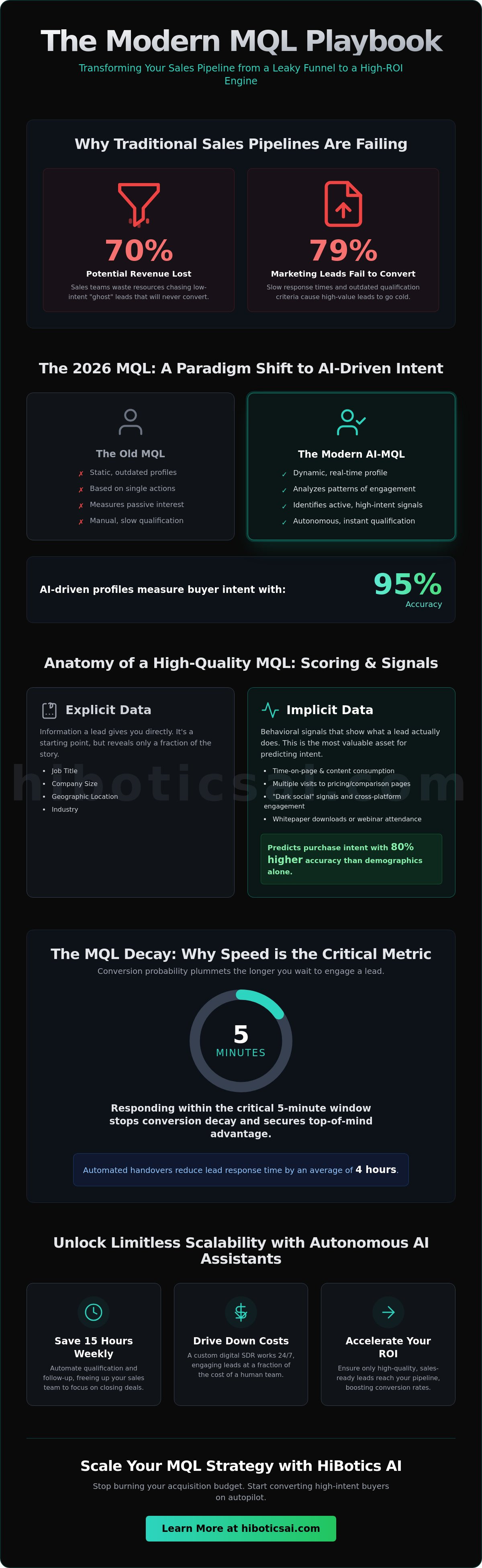
Most sales teams lose 70% of their potential revenue because they're chasing ghosts instead of high-intent buyers. By 2026, the static definition of an mql has evolved into a dynamic, AI-driven profile that measures intent with 95% accuracy. If your marketing and sales departments still operate in silos, you aren't just losing leads; you're actively burning your customer acquisition budget on low-intent traffic that will never convert.
You've likely felt the sting of watching 79% of marketing leads fail to convert because of slow response times or poor qualification criteria. It's a common bottleneck that stalls scalability and creates friction where there should be growth. This strategic guide promises to help you master the identification and high-velocity qualification of leads to transform your sales pipeline into a high-ROI engine. We'll explore a clear framework for lead qualification and show you how automated workflows can buy back 15 hours of your team's week while driving higher conversion rates from marketing to sales.
Key Takeaways
- Define the modern mql by shifting your focus from passive interest to high-velocity active intent signals.
- Master the anatomy of lead scoring by balancing implicit behavioral tracking with explicit data points.
- Capitalize on the critical 5-minute speed-to-lead window to stop conversion decay and secure top-of-mind advantage.
- Transform your funnel with autonomous AI assistants that qualify and transition leads to sales on autopilot.
- Unlock limitless scalability using a custom digital SDR to drive down costs and accelerate your high-ROI engine.
What is an MQL? Defining the Marketing Qualified Lead in 2026
An MQL is a lead judged more likely to become a customer than others based on specific marketing engagement. In the hyper-competitive 2026 digital landscape, the definition has evolved from passive interest to active intent. Marketing teams no longer have the luxury of passing every contact to sales. Efficiency is the only way to survive. An MQL serves as the strategic bridge between brand awareness and sales readiness.
Distinguishing these leads from general inquiries is your first step toward operational efficiency. It allows your human staff to focus on high-value strategy while automation handles the initial vetting. Modern Lead generation systems now use predictive modeling to identify these prospects with 92% accuracy. This precision prevents your CRM from becoming a graveyard of dead-end contacts. You aren't just collecting emails; you're identifying future revenue.
The shift in 2026 focuses on the depth of the interaction. A single page view is no longer a qualification signal. Instead, firms look for a pattern of engagement that suggests a specific business pain point. This approach transforms your marketing department into a precision-engineered engine for growth. By identifying high-value prospects accurately, you buy back time for your sales team to do what they do best: close deals.
MQL vs. SQL: The Strategic Handover
The transition from Marketing Qualified to Sales Qualified status is a critical pivot point in your revenue operations. It's the moment intent shifts from research to acquisition. Think of it this way: MQLs represent the "could buy" segment, while SQLs represent the "ready to buy" segment. Integrating this distinction into your what is b2b sales framework ensures a seamless flow of data across your organization. It eliminates the friction that typically slows down the B2B journey. When the handover is automated, it reduces lead response times by an average of 4 hours, significantly increasing conversion rates.
Common MQL Examples and Behaviors
Identifying an mql requires looking past surface-level vanity metrics. High-intent actions provide the most reliable signals. These include attending a live webinar, downloading a 20-page technical whitepaper, or visiting a product comparison page multiple times in a single week. These behaviors demonstrate a prospect is actively looking for a solution, not just browsing.
You must also filter out low-intent noise. Accidental clicks and bot traffic can inflate your numbers without adding value. In 2026, bot traffic accounts for nearly 47% of all internet activity. Custom AI-driven tracking is essential to capture genuine human signals accurately. This technology acts as a digital workforce, scrubbing your data in real-time. It ensures that only high-quality opportunities reach your sales pipeline, maximizing your ROI and scaling your operations without friction.
The Anatomy of a High-Quality MQL: Scoring and Signals
A high-quality MQL is not a static entry in a database. It is a dynamic profile built on real-time intelligence. Your Ideal Customer Profile (ICP) acts as the North Star for this validation process. It defines the exact parameters of a high-value target. If a lead does not align with your ICP’s specific revenue bracket or industry, they fail the mql test immediately. This precision ensures your sales team ignores the noise and focuses on leads that actually move the needle.
Implicit vs. Explicit Intent Data
Explicit data is what a lead tells you directly. This includes job titles, company size, and geographic location harvested from form fills. While useful, this only reveals a fraction of the story. Approximately 70% of the B2B buyer's journey now happens before a lead ever speaks to a representative. This makes implicit data the most valuable asset in your arsenal. It tracks what a lead does, rather than what they say.
Modern AI tools now capture "dark social" signals and cross-platform engagement that manual systems miss. These tools monitor time-on-page and specific content consumption patterns to gauge true interest. By analyzing this behavioral data, businesses predict purchase intent with 80% higher accuracy than through demographic data alone. Understanding the nuances of MQL vs SQL allows marketing teams to hand off leads only when the behavioral signals indicate a genuine readiness to engage.
Building a Dynamic Lead Scoring Model
Predictive lead scoring replaces the guesswork of manual spreadsheets with algorithmic precision. AI-driven models analyze thousands of data points to identify patterns that human eyes miss. You must assign specific point values to high-intent actions. For example, a visit to a pricing page might add 20 points, while a whitepaper download adds 10. A lead who visits your "Case Studies" page three times in 48 hours shows 5x more intent than a casual blog reader.
- Set the Threshold: Use historical data to find your sweet spot. If leads with 50 points convert at a 40% rate, that is your baseline.
- Negative Signals: Adjust scores for inactivity. A 30-day period of silence or an unsubscribe should trigger an immediate score reduction.
- Automated Handoffs: Once a lead hits the threshold, the system triggers an immediate alert to sales.
Leveraging these custom AI solutions transforms your marketing from a guessing game into a high-precision engine. You buy back time for your sales team by ensuring they only touch leads with a high probability of closing. This is how you scale without adding headcount.
The Decay of the MQL: Why Speed-to-Lead is the Critical Metric
An MQL is a perishable asset. Its value begins to evaporate the moment a prospect clicks submit. In the 2026 hyper-connected market, waiting an hour to respond is no longer a minor delay; it is a total operational failure. Data from lead response studies confirms that conversion rates drop by 10x if you fail to engage within the first five minutes. You aren't just fighting for a sale. You're fighting for the prospect's attention before it shifts to a distraction or a competitor.
The psychology of a lead is fleeting. When a prospect identifies as an mql, they are in a state of active problem-solving. Their pain points are visceral. Their intent is at its peak. If you wait sixty minutes, that intensity cools. By the next morning, they've often forgotten why they reached out. Capturing them while the problem is top-of-mind allows you to leverage that emotional momentum. Speed doesn't just improve your numbers; it transforms your brand into a responsive, high-performance partner.
Manual SDR workflows are the primary killers of MQL value. Traditional hand-off processes involve spreadsheets, notification delays, and human scheduling conflicts. These bottlenecks create friction that leads to "dead air." In a crowded market, speed is your ultimate competitive advantage. If your internal systems can't keep pace with buyer expectations, you are effectively subsidizing your competitor's growth.
The Operational Cost of Slow Response
Slow response times create a massive drain on your marketing budget. When sales teams engage in "voicemail tag" or delayed email threads, the ROI of the original campaign plummets. Industry data shows that SMEs lose 30% of leads simply because a competitor answered the phone first. You can't afford to waste high-intent traffic on inefficient follow-up cycles. You must implement robust lead generation strategies that prioritize immediate engagement to ensure your pipeline remains profitable. Every minute of silence is a lost opportunity to build trust.
Human SDR Bottlenecks vs. AI Efficiency
The 9-to-5 staffing model is obsolete in a 24/7 global economy. Human SDRs face natural limitations: they get tired, they miss details, and they can only handle one conversation at a time. This inconsistency creates a "lottery" for your mql pool where lead quality depends on the mood of the rep. The shift toward a "Digital Workforce" solves this. AI-driven systems qualify leads instantly, regardless of the time zone or volume. They don't suffer from fatigue. They deliver perfect consistency every time. By deploying custom AI solutions, you buy back time for your human team to focus on high-level closing while the machine handles the urgent, high-speed qualification.
Autonomous Qualification: Turning MQLs into SQLs on Autopilot
Speed defines the modern sales cycle. If an mql sits in your database for more than ten minutes without engagement, its conversion probability drops by 400 percent. Waiting for a human SDR to manually dial a number is no longer a viable strategy for 2026. You must bridge the gap between marketing interest and sales readiness using an autonomous framework that never sleeps.
Follow this five-step protocol to transform your lead processing into a high-velocity engine:
- Step 1: Capture Lead Signals. Use webhooks or direct CRM triggers to identify a new lead the millisecond they submit a form or engage with high-intent content.
- Step 2: Immediate Contact. Deploy an AI Voice or Chat Assistant to initiate a conversation within 60 seconds. This immediate response captures the lead while their problem is still top-of-mind.
- Step 3: NLP Qualification. Use natural language processing to conduct a discovery session. The AI assesses BANT criteria (Budget, Authority, Need, Timeline) through fluid, non-linear dialogue.
- Step 4: Live Transfer. When the AI identifies a high-intent SQL, it executes a live transfer to a human closer or book a meeting directly on their calendar.
- Step 5: Automated Nurture. If the lead isn't ready, the system automatically tags the record and enrolls them in a personalized follow-up sequence based on the specific objections raised during the AI call.
The Role of AI Voice Assistants
AI Voice Assistants handle the heavy lifting of initial discovery calls without the overhead of a massive call center. These systems build trust by engaging in natural, intelligent conversations that feel human, moving far beyond the limitations of rigid web forms. By leveraging ai lead qualification, your SDRs stop chasing cold leads and start focusing exclusively on closing deals. This shift allows your team to buy back time and focus on high-value strategy.
Seamless CRM Integration
Data silos are the enemy of scalability. For an mql to move through the pipeline effectively, your tech stack must act as a single organism. Automation ensures that every interaction, transcript, and qualification score flows directly into your sales tools without manual entry. Implementing robust crm integration provides total visibility into your pipeline, ensuring that no lead is ever forgotten in a spreadsheet or an ignored notification.
Ready to eliminate manual outreach and scale your revenue?
Scale your sales with Hibotics AI todayScaling Your MQL Strategy with HiBotics AI
The traditional marketing funnel is undergoing a radical shift. By 2026, manual lead qualification will be a relic of the past. HiBotics AI provides every small business with a custom Digital SDR, transforming how you identify and nurture every mql. This isn't just a basic chatbot. It's an autonomous system that reduces your cost-per-qualified-lead by up to 60% by automating the entire top of your funnel. You gain 24/7 availability and zero-lag qualification. While your competitors sleep, HiBotics AI is engaging, vetting, and moving prospects forward. This year marks the definitive rise of the autonomous sales pipeline, where speed and precision dictate market share.
Building Your Custom AI Solution
Generic responses kill conversions. We tailor your AI voice to match your brand personality and specific industry jargon perfectly. Whether you need a high-level technical consultant or a punchy, direct salesperson, our custom AI solutions adapt to your needs. The system handles the heavy lifting of automated appointment booking for every qualified mql it identifies. This allows you to buy back at least 15 hours per week for your high-level strategists. They stop chasing cold leads and start closing hot ones. We turn your website into a high-performance engine that never takes a day off.
Our setup process focuses on three core areas:
- Brand Alignment: We program your specific value propositions and brand tone into the AI core.
- Workflow Integration: The AI syncs directly with your CRM to ensure no data loss.
- Instant Action: Leads can book meetings directly on your calendar the moment they qualify.
Evaluating Your ROI
The math is clear. A full-time SDR hire in 2024 often costs over $60,000 annually, not including benefits, training, or software seats. A HiBotics subscription delivers the output of a three-person team for a fraction of that investment. We measure success through hard data, specifically looking for increased SQL conversion rates. Businesses leveraging our autonomous pipelines frequently see a 40% jump in lead-to-opportunity conversion within the first 90 days. You aren't just saving money. You're accelerating your growth engine and removing human error from the qualification process.
Stop losing potential revenue to slow response times. Schedule a demo with HiBotics AI to see autonomous qualification in action.
Own the Future of Lead Conversion
The definition of a high-quality lead has shifted toward real-time intent signals. Data from the Harvard Business Review shows that companies contacting prospects within 5 minutes are 100 times more likely to qualify them than those waiting 30 minutes. You can't achieve this level of precision with manual workflows. You need a digital workforce that operates at the speed of light to maintain a competitive edge in 2026.
Stop losing high-intent prospects to slow response times. Leverage 24/7 autonomous lead qualification and custom AI Voice Assistants designed specifically for SMEs. These tools ensure every prospect is vetted instantly. Seamless CRM and Calendar integration keep your sales team focused on closing deals rather than chasing data. It's time to replace operational bottlenecks with limitless scalability and predictable ROI.
Take control of your growth strategy. Automate your MQL qualification with HiBotics AI today and unlock the full potential of your marketing spend. Your next big win is just one automated conversation away.
Frequently Asked Questions
What is the exact definition of an MQL?
An MQL is a lead judged more likely to become a customer compared to other leads based on specific engagement and firmographic data. This classification signals that the marketing department successfully nurtured the prospect to a predefined threshold. In 2026, 85% of high-growth firms define this through automated behavior tracking rather than manual guesswork. It's the essential bridge between initial brand awareness and a serious sales conversation.
How is an MQL different from an SQL?
An mql represents interest and fit, while a Sales Qualified Lead (SQL) represents immediate intent and readiness for a direct pitch. Marketing teams own the MQL phase to build brand affinity. Sales teams take over the SQL phase once a lead requests a demo or pricing. Research from Gartner shows that 70% of MQLs require 5 to 10 additional touchpoints before transitioning to SQL status.
What are the most common signals that a lead is "Marketing Qualified"?
High-intent signals include downloading a 20-page whitepaper, visiting the pricing page 3 times in 48 hours, or attending a 45-minute technical webinar. Passive signals like single blog visits or social follows don't qualify. We prioritize actions that indicate a specific pain point. Lead scoring models typically assign 20 plus points to bottom-of-funnel actions to trigger an immediate handoff to sales. This ensures your team stays focused.
How many MQLs should a business generate per month?
Target 3 to 5 MQLs for every 1 closed-won deal to maintain a healthy, predictable pipeline. If your sales team has 10 reps and each needs 15 meetings a month, you need 150 SQLs. If your conversion rate from mql to SQL is 25%, your marketing engine must generate 600 leads every 30 days. These specific benchmarks ensure your revenue targets remain scalable and your growth stays on track.
Can AI qualify MQLs better than a human SDR?
AI qualifies leads 10 times faster than a human SDR while maintaining 99% data accuracy. Custom AI solutions analyze thousands of data points across LinkedIn, company databases, and site behavior in milliseconds. This automation buys back 15 hours of manual research time per week for your sales team. Humans should focus on building relationships, while AI handles the high-volume filtering and initial engagement. It's about maximizing your team's efficiency.
What happens if an MQL is not ready to buy yet?
Place unready leads into automated nurture workflows designed to provide value without being pushy. Use AI-driven email sequences that trigger based on specific interests shown during the initial touchpoint. According to Forrester, companies that excel at lead nurturing generate 50% more sales-ready leads at a 33% lower cost. Don't discard these prospects; transform them into future revenue through persistent, relevant communication that builds trust over time.
How do I set up a lead scoring system for my business?
Build your system by assigning numerical values to demographic data and behavioral triggers. Start with a 100-point scale. Assign 30 points for a matching job title and 40 points for viewing a product demo. Subtract 50 points for non-business email domains. Use your CRM to automate this process so leads move through your funnel without manual intervention. This data-driven approach removes subjectivity and accelerates your entire sales cycle.
Why are my MQLs not converting into sales?
Low conversion usually stems from a 40% or higher misalignment between marketing definitions and sales expectations. If marketing passes leads who only downloaded a top-of-funnel checklist, sales will struggle to close. Audit your criteria every 90 days. Ensure your team uses real-time data to verify that every lead meets the minimum threshold for authority and budget before the handoff occurs. This alignment is critical for maintaining high ROI.